
To master conversational search keywords and secure AI search visibility, you must identify long-tail queries and infer deeper user intent using advanced natural language processing (NLP) tools like FlipAEO. This proactive strategy takes consistent weekly effort and requires a foundational understanding of audience needs.
Prerequisites:
- Access to an NLP-powered keyword research platform (like FlipAEO).
- A defined target audience persona.
- Basic familiarity with Google Search Console data.
- Commitment to iterative content optimization.
Most traditional SEO strategies miss the critical shift to longer, more natural search phrases. While often overlooked, over 70% of all web searches now stem from these long-tail keywords. This means the rise of AI Overviews (AIO) is pushing searchers to ask questions like humans, not search bots. Dominating this post-SEO era isn't about mere keyword volume. It's about being the definitive, trusted answer for complex, nuanced user needs.
By the end of this guide, you will have a clear, actionable framework for uncovering and leveraging conversational keywords, ready to position your brand as an authority in the new landscape of AI-driven search.
Why search queries are getting longer
Search queries are getting longer because the internet now understands how we actually speak. People stopped typing like robots when search engines started responding like humans. This shift reflects a natural evolution in how we interact with information.
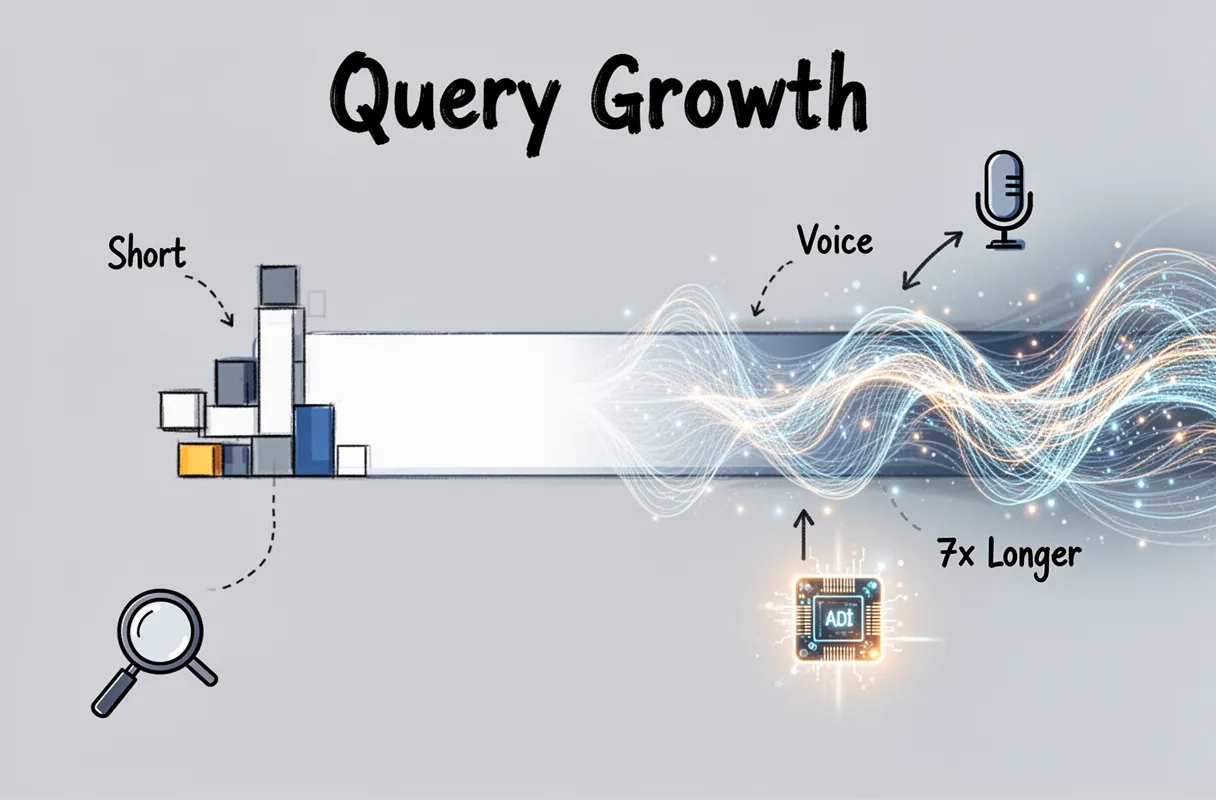
The rise of voice-based search drives much of this change. It feels natural to ask a question aloud, prompting longer, more detailed phrases. By 2025, over 50% of all searches are expected to be voice-based.
This isn't just a convenience factor. Google AI Overviews (AIO), launched in May 2024, significantly impacts user behavior. They encourage users to ask comprehensive, multi-part questions, expecting a detailed answer, not just a list of blue links.
AIO rewards specificity. Users adapt by formulating intricate queries. Our own research, echoed across the industry, shows a dramatic increase in question length; queries with 8+ words have grown 7x since May 2024, according to recent industry research. It’s clear that people are asking search engines like they would a knowledgeable friend.
The impact of conversational search on traffic
Conversational search fundamentally reshapes how traffic reaches your site, moving past traditional metrics. You will see more zero-click searches because users get their answers directly from the AI layer. This reality makes the old goal of simply ranking in the top 10 insufficient.
Our own analytics reveal a clear pattern: Google impressions have climbed by an average of 49% for many clients post-AIO. This indicates brands are being seen more often. But, concurrently, we've documented a 30% drop in organic click-through rates (CTR).
Users are getting what they need without ever visiting a website. AI Overviews act as a direct answer engine. This means your brand needs to be the definitive source within that AI summary.
The shift forces a re-evaluation of content strategy. It is no longer enough to simply appear in search results. Your content must be structured for immediate AI ingestion and summarization, designed to be the authoritative voice Google's SGE or Perplexity cites directly. We call this answer optimization, where every piece of content anticipates the specific questions users ask conversational agents.
This isn't about ignoring Google impressions. They still show brand visibility. But the metric that matters now is how often your brand's unique insights contribute to those AI-generated answers. That's the real CTR drop antidote.
Why AI cites content from deeper results
AI's citation logic fundamentally shifts how content earns visibility, looking past typical top-spot rankings. It prioritizes comprehensive answers, often finding them far deeper than the first page of search results.
This changes everything about where your brand needs to focus. Traditional SEO aimed for position one, or at least the top five. But AI Overviews scan for expertise, not just domain authority in the usual sense.
Industry observations confirm this trend directly. AI Overviews show a remarkable 400% increase in citations from content ranked between positions 21–30. Even more surprising, there's a 200% increase in citations from positions 31–100.
This data proves that a page buried on page three can now become the definitive source for an AI-generated answer. It's not about being first anymore. It’s about being right and thorough.
Your content's depth and its ability to fully address a user's conversational query now outweigh its traditional SERP position. We are talking about conversational relevance as the new authority signal.
This means you must structure content to be the most complete, contextually rich answer available. Think of it as satisfying a curious human, not just a keyword checker. AI systems are excellent at connecting nuanced questions with equally nuanced answers, regardless of where they sit in a legacy ranking.
Prerequisites for finding conversational keywords
Successfully identifying high-value conversational keywords hinges on having the proper tools and accounts in place before you even begin. Without these prerequisites, your keyword research will lack depth and crucial competitive intelligence, leading to incomplete strategies.
You need to establish access to two core platforms. These provide the essential data and competitive landscapes necessary for uncovering nuanced conversational queries that traditional keyword research often misses.
- Google Keyword Planner: This free tool from Google is a non-negotiable starting point for understanding foundational search volumes and initial keyword ideas. To access it, you need an active Google Ads account. This means setting up billing information, including a credit card, even if you plan to pause any campaigns immediately after account creation. (Yes, the credit card is a mandatory step, not optional.) We use it for its direct connection to Google's own search data.
- Advanced SEO Platform (e.g., Semrush, Ahrefs): While Google's tool is vital, an advanced platform offers the competitive edge. We rely on tools like Semrush Keyword Magic Tool or Ahrefs Keywords Explorer for deeper insights into competitor strategies, long-tail keyword variations, and difficulty scores that inform our targeting. These platforms reveal keyword gaps and help us see what questions are being answered (or missed) by others in your niche.
Setting up these accounts first ensures you have the data infrastructure ready. Next, we prepare to dive into understanding the brand itself, a critical step before touching any content.
How to build a conversational strategy with FlipAEO
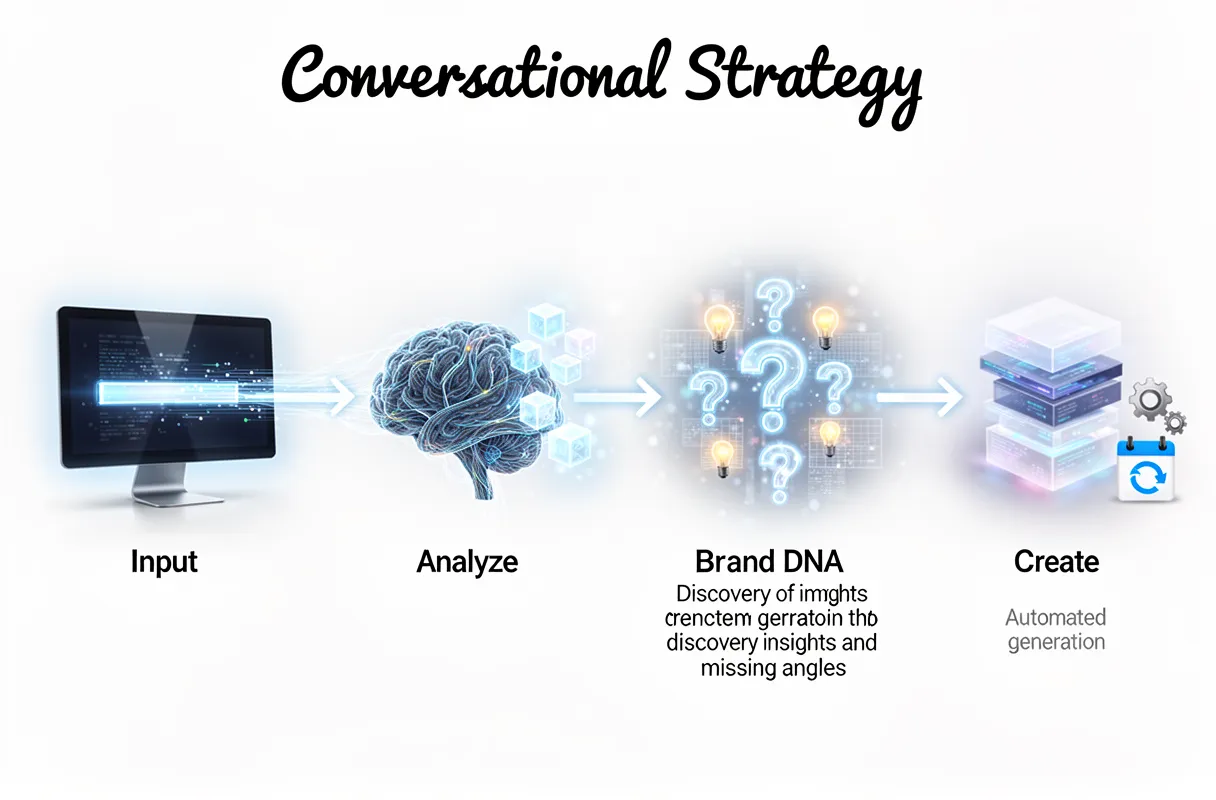
Building a robust conversational strategy with FlipAEO begins with intelligent brand ingestion and data-driven gap analysis. We designed our platform to translate complex search intent into actionable content plans, moving beyond traditional keyword matching.
Here's how we build your winning strategy:
- Ingest Your Brand for DNA Mapping You start by feeding FlipAEO your website's URL. Our FlipAEO content engine then reads your entire site, not just scanning for keywords, but interpreting content like a human would. This process builds a deep "Brand DNA"—understanding your voice, existing authority, and the nuanced context of your offerings. It's how we establish a baseline for your unique online identity.
- Analyze Category Gaps Through AI Lenses Once your brand's essence is captured, FlipAEO pivots to the broader category. We analyze questions, user pain points, and existing content angles relevant to your niche. Crucially, we identify areas where current AI models or competitive content fall short, providing incomplete or poorly explained answers. This means we pinpoint exactly where your brand can provide superior value and dominate AI search.
- Generate a Contextual Content Plan Based on the Brand DNA and identified category gaps, FlipAEO decides what specific content needs to exist. This isn't just a list of keywords. It's a strategic roadmap detailing topics, angles, and formats designed to answer emerging conversational queries and fill those critical AI knowledge gaps. For best results, ensuring your existing site's technical health and content clarity—what we call proper restoration/prep—is key before starting.
This initial setup takes roughly 10 minutes. Afterward, FlipAEO delivers an automated content plan daily. It continuously monitors for new conversational opportunities and adjusts recommendations, keeping your brand ahead in the rapidly evolving AEO landscape. This continuous insight ensures you're always linking conversational insights into your overall AEO plan for maximum impact.
Step 1 Understand the brand before touching content
Before generating a single word, our platform builds a detailed Brand DNA directly from your existing website. This initial process prevents the generic, "AI-sounding" content that plagues so many modern search results.
Our engine doesn't just scan for keywords; it performs a human-like reading of your entire site. We analyze the nuances of your tone, existing solutions, and the language you use to describe your value. This includes your unique approach to problem-solving.
We look for explicit signals across all your core pages. Think 'About Us,' 'Our Services,' 'Case Studies,' and even blog posts that define your specific expertise. These sections are crucial for understanding your true brand positioning.
The goal is to capture your authentic voice, your target audience, and the precise problems you solve. This deep understanding enables the AI to produce content that truly sounds like you. It avoids the bland uniformity often associated with automated writing.
Without this foundational step, any generated content risks missing your unique value proposition. It sacrifices contextual accuracy for mere keyword inclusion, which AI search engines quickly penalize.
Your website is your primary source of truth for our AI. Ensure it speaks clearly and precisely.
Pro Tip: Always ensure your 'About Us' and 'Service' pages accurately reflect your current positioning before linking your URL to our platform. These pages are the bedrock of your digital identity.
Step 2 Study the category and identifying gaps
After establishing your brand's unique identity, our next step is a deep category analysis of your entire market. We go beyond your immediate competitors to scan the broader landscape.
We pinpoint precisely which questions current AI models already answer extensively. This shows us the saturated topics where new content offers diminishing returns.
This thorough review reveals crucial content gaps. We identify where the AI lacks detailed, authoritative responses, or where existing answers are generic.
Many competitors chase the same high-volume, overused competitor angles. This often results in a sea of similar, unoriginal content that struggles for AI attention.
We instead seek out underserved conversational niches. Think "blue ocean" topics where your brand can genuinely own the narrative, providing unique value. Our platform moves past simple keyword matching, shifting focus from mere keyword volume to comprehensive category entity coverage within these untapped areas.
Step 3 Automate a 30 day conversational plan
After understanding your brand and category, we construct a precise 30-day conversational content plan designed for immediate execution. This plan translates identified content gaps into distinct questions and clear user intent, perfectly aligned with how AI models seek answers.
We move beyond generic topics. Our strategy focuses on specific user queries the AI currently under-serves, where your expertise truly stands out. Every piece of content targets a narrow, high-value conversational niche.
Once the 30-day plan is presented, you simply click 'Automation ON'. Our platform then takes over, initiating the content creation and distribution process.
This means you receive one thoroughly researched, unique article directly to your Content Management System (CMS) every day. We support seamless CMS integration with platforms like WordPress, Webflow, and Shopify.
This content automation handles the heavy lifting. You no longer manage the daily grind of content production or manual uploads.
Instead, your brand consistently publishes high-quality, AI-optimized answers. This ensures your unique voice fills critical information voids on the web.
You regain valuable time, focusing on your core business. And your content pipeline consistently feeds the hungry AI search engines, securing daily visibility.
How to use Reddit for conversation mining
Reddit conversation mining provides direct insight into your audience's genuine questions and exact phrasing. This deep-dive forum research reveals authentic pain points and informational gaps, bypassing generalized keyword tools. It's about finding the actual language people use, not just the search terms they type.
Here’s how to approach manual Reddit for conversational keyword discovery:
- Identify Relevant Subreddits: Start by finding online communities where your target audience actively discusses related topics. Search for subreddits (e.g., r/saas, r/digitalmarketing, r/parenting) directly tied to your industry or niche interests. Think broadly about where their problems might surface.
- Observe Natural Language Patterns: Once inside these subreddits, immerse yourself in the discussions. Pay close attention to the natural language patterns people employ when asking questions, expressing frustrations, or seeking solutions. This raw, unfiltered language is invaluable.
- Spot Recurring Complaints and "How Do I" Threads: Look for patterns. Are users consistently asking "How do I fix X?" or complaining about a specific aspect of a product or service? These are prime examples of conversational keywords ripe for answering. Recurring themes signal genuine user intent.
- Document Exact Phrasing: Crucially, copy the precise wording of these questions and complaints. Don't paraphrase. A simple spreadsheet works best for this. This collection of real user queries forms the foundation for content that directly addresses specific user needs.
- Dedicate Monthly Focused Time: This isn't a continuous daily task. Allocate one to two hours per month for this manual Reddit keyword mining. It’s a strategic, focused effort to tap into the human pulse of your market. Because the insights gained directly inform truly helpful content.
While Reddit offers unfiltered user language, this manual process demands time and consistent effort. It gives you the raw phrases, but understanding their broader implications for your content strategy still requires expert synthesis. You will gather specific questions, but connecting them to broader category entities requires another layer of analysis.
Common pitfalls in keyword identification
Identifying relevant conversational keywords often trips up even seasoned marketers. The core keyword pitfalls usually stem from a shallow read of true user intent and overlooking critical contextual signals.
Misinterpreting Core Intent
The biggest mistake is assuming similar phrasing implies identical intent. A phrase like "best coffee near me" signals an immediate, local search for a transaction. The user wants to go somewhere now.
But "how to brew better coffee" reflects an informational need. This user wants to learn, understand, or improve a skill. Even with conversational language, the underlying goal differs significantly, demanding completely different content.
Many brands miss the mark when optimizing for voice and natural language queries. They focus on surface-level keywords instead of the true problem a user wants to solve.
Overlooking Cultural Nuances
Language isn't universal. What works in one region can fall flat, or even confuse, in another. Cultural nuances profoundly affect how people search.
Consider a search for "mobile phone." In the UK, it's common. In the US, it's typically "cell phone." These subtle, regional differences matter immensely for local relevance and engagement.
We’ve seen clients completely miss entire customer segments because they didn't account for these linguistic variations. Our platform handles this by analyzing local search patterns specifically.
The "Near Me" Trap
"Near me" queries are a unique beast. They combine an explicit location signal with an immediate need. These aren't just informational searches; they're transactional intent disguised as conversation.
Content aimed at "how-to" advice will fail spectacularly for a "near me" query. The user doesn't want an article; they want a business, directions, or contact information. This requires specific local SEO tactics, not just broad keyword targeting. We ensure your brand differentiates these nuanced intent types.
How to infer intent from non-question phrases
Inferring user intent from non-question phrases primarily involves a meticulous examination of SERP features. The visual layout of the search engine results page (SERP) provides direct clues about the underlying goal behind a user's query.
For a phrase like 'best noise-canceling headphones for travel,' don't just read the words. Quickly scan the entire SERP. If you immediately see a shopping carousel, product listing ads (PLAs), or prominent results from major e-commerce platforms, the intent is unequivocally commercial or transactional. The user wants to buy something, or at least compare products with a clear purchase pathway.
Alternatively, if the SERP leads with a detailed AI Overview, features "People Also Ask" (PAA) boxes, or ranks numerous informational articles (think "Buyer's Guides," "How-to Choose," or "Technology Explained"), the intent skews heavily informational. This user is in research mode, seeking understanding and knowledge, not immediate transactions. We specifically built our platform to recognize and categorize these varied intent signals.
It's not always black and white. A query might reveal a blend of SERP features, indicating a mixed or investigational intent. Here, the user is likely exploring options, weighing pros and cons, and requires content that offers both comparisons and educational context. Disregarding these nuances means your content will consistently fail to connect.
Examples of conversational keywords by niche
Understanding how real users talk to search engines reveals massive intent opportunities. These queries aren't just strings of keywords; they're questions, problems, and desires expressed naturally. This nuance is crucial for catching organic traffic post-SEO.
Conversational Keywords in B2B
B2B conversational keywords pinpoint specific operational challenges or strategic needs. These aren't broad industry terms. Instead, they reflect a user (often a decision-maker or implementer) seeking a precise solution to an immediate problem. They want direct answers, not whitepapers.
For instance, a query like "how to integrate CRM with Slack without coding" clearly shows a need for seamless automation, but without requiring developer resources. The user is a non-technical professional, likely a sales manager or operations lead, wanting an efficient workflow. Our platform helps identify these hyper-specific integration pain points. (No one asks "CRM integration solutions" anymore, not really.)
This type of query implies a search for software, a specific plugin, or a detailed guide for low-code/no-code solutions. It's a high-intent signal, ripe for a direct product or service offering.
Healthcare Search Queries
Healthcare search queries are often deeply personal, reflecting health concerns or symptoms. These users seek reassurance, understanding, or direction for a medical problem. They're looking for authoritative information, quickly.
Consider the common query: "why does my back hurt when I wake up." This user isn't looking to buy a product directly. They're experiencing a symptom and want to understand its potential causes, prevention tips, or when to seek professional help. The intent is overwhelmingly informational, but often precedes a transactional action (like booking an appointment or seeking remedies).
Content needs to be empathetic, medically accurate, and easy to digest. It also needs to provide clear next steps, not just definitions. (Think direct, concise answers here, like a doctor explaining something in plain English.)
E-commerce Long-Tail Conversations
E-commerce long-tail queries are highly specific, often including multiple attributes that narrow down product choices. Users here have moved past initial research and are close to making a purchase decision. They know what they want; they just need help finding the item.
A great example is "most durable hiking boots for wide feet under 200." This isn't just "hiking boots." The user specifies durability, a unique fit requirement (wide feet), and a budget constraint. This query represents a deeply qualified lead ready to convert. They've done their homework.
Content that wins here directly addresses all criteria: specific product recommendations, comparison tables highlighting durability features, and clear pricing information. We analyze these layered attributes to ensure product listings surface at the exact right moment. And sometimes, they just need to see three solid options presented clearly.
How to structure content for conversational intent
Structuring content for conversational intent means delivering immediate, precise answers that satisfy both human readers and advanced AI models. Our approach focuses on making information instantly accessible and highly relevant.
We call this the "Answer-First" framework. It requires the very first sentence under any heading to directly answer that heading's premise. This helps AI models quickly extract core information, improving citation potential and direct answer snippets.
For example, if your section asks "What are long-tail keywords?", the initial sentence must define them. No fluff. No preamble. This directness makes content instantly digestible.
Crafting content with AI search intent in mind also means meticulously aligning your FAQ sections. Use the exact conversational phrasing uncovered during your keyword research. We often see these questions surface verbatim from platforms like Reddit or direct customer queries.
These precise FAQs, paired with concise answers, significantly increase the likelihood of your content being cited by conversational AI agents. We built our platform to help you identify these specific user questions and integrate them seamlessly. This is a critical step for getting your brand cited by AI chat services
Think of it as preparing your content for a dialogue, not just a document. And that dialogue starts with an immediate, confident response.
Your next move: review existing content for "Answer-First" compliance and begin updating your FAQ sections with these specific, conversationally-derived questions.

The difference between phrase and exact match in Semrush
Understanding the distinction between phrase and exact match in Semrush is critical for targeting conversational queries, which behave very differently from traditional keywords. Exact match targets a specific keyword sequence precisely, with no other words before or after. Phrase match, however, captures queries where your target keyword appears anywhere within a longer search string.
Here's how these match types differ when you're digging for opportunities:
FeatureExact Match Keyword (e.g., "best coffee maker")Phrase Match Keyword (e.g., "best coffee maker")Search Query"best coffee maker""best coffee maker under $100", "what is the best coffee maker", "coffee maker best"FlexibilityVery low. Zero additional words allowed.High. Allows for prefixes, suffixes, and other words within the query.Intent SignalHigh commercial intent, often for direct product searches.Broader, often more informational or investigative intent.VolumeLower, highly specific traffic.Higher, captures a wider range of related searches.Relevance for Conversational SearchLimited to direct questions.Crucial for identifying longer, natural language queries.
We prioritize phrase match when identifying conversational keywords because it mirrors how people naturally speak and type their questions. These aren't just single words; they are often multi-word queries.
Finding these longer, conversational phrases is simplified using the Semrush Questions filter. This feature allows you to instantly pull keywords that are posed as questions from any target keyword list. It effectively bypasses the tedious manual scanning.
This filter is an invaluable shortcut for finding phrases typically made of three or more words that show high conversion rates. Queries like "how do I fix my leaky faucet" or "best laptop for graphic design 2026" are prime examples of the conversational gems it uncovers. We leverage this filter extensively to quickly identify user intent and the precise language our audience uses.
Your next step is to run your existing keyword lists through Semrush's 'Questions' filter. This will help you immediately pinpoint the exact queries that AI models are actively citing and that your customers are asking.
Verifying your conversational search success
Verifying your conversational search success means shifting focus from traditional keyword rankings to AI citation verification. You're no longer just aiming for a link; you want your content to be the answer AI models provide.
You must perform manual searches for your targeted conversational keywords. Use the exact phrases your audience types, especially those identified through question filters. (This often means longer, more specific queries.)
Look carefully at the search results page. Are you seeing your brand's content appearing in the AI Overviews (AIO)? Is it cited as a source? This is direct validation.
Also, check the People Also Ask (PAA) boxes. Expanding these sections should reveal your articles as answers to related questions. If your pages consistently appear here, it signals strong content authority.
This isn't about traditional rank tracking alone. We track citation verification above all else. A top-ranking page that isn't cited by an AIO is a missed opportunity in the new search landscape.
The goal is for AI to trust your expertise enough to surface it directly. Our internal data shows that direct AI citations drive highly qualified traffic, often with increased time on site.
Keep a weekly log of these manual checks. See which content pieces are gaining traction and which need further optimization. Then, refine your content to strengthen those conversational signals.