
Digital PR for SEO and AI is the strategic integration of public relations and advanced SEO techniques, designed to build brand authority and topical relevance that AI search engines prioritize for Answer Engine Optimization (AEO). This approach shifts focus from traditional backlinks to authentic online mentions, driving higher AI search visibility.
Key Characteristics:
- Primary Goal: Establish brand authority and trust.
- Key Technology: Optimized for LLMs, SGE, and other AI search platforms.
- Target Audience: AI users seeking direct, authoritative answers.
- Core Metric: Quantity and quality of brand mentions and citations.
AI search traffic surged by an astonishing 527% between 2024 and 2025. This explosion radically reshapes how brands achieve online visibility, fundamentally changing the rules of the game. The old currency of backlinks alone no longer dictates search performance; instead, AI models like Google's AI Overviews and ChatGPT actively seek out legitimate brand mentions and deep topical authority.
By the end of this guide, you will master the principles of digital PR for AI visibility using strategic content and outreach, without relying on outdated SEO tactics that AI now often ignores.
What is digital PR in the age of AI search?
Digital PR in the age of AI search is about earning genuine online mentions and building trust, blending classic storytelling with digital tactics to capture attention where AI engines and customers already look. This goes far beyond mere "buzz" or fleeting viral moments.
Instead, we focus on securing high-quality earned media in the specific, trusted places that large language models (LLMs) value for their contextual understanding. Think authoritative industry publications, niche forums, and expert-driven content hubs.
It is a strategic approach designed to establish your brand's topical authority. When AI models, like those powering Google's AI Overviews, evaluate information, they prioritize entities with consistent, credible mentions from recognized sources.
This emphasis makes digital PR a critical tool in 2026. Google's AI Overviews already reach 2 billion users, and they are actively synthesizing answers from recognized, authoritative brand signals. If your brand isn't mentioned in those trusted sources, you simply won't appear.
You cannot just rely on traditional SEO signals anymore. We see digital PR as the proactive method for shaping your brand's digital narrative, directly influencing what AI search perceives as a reliable, authoritative source.
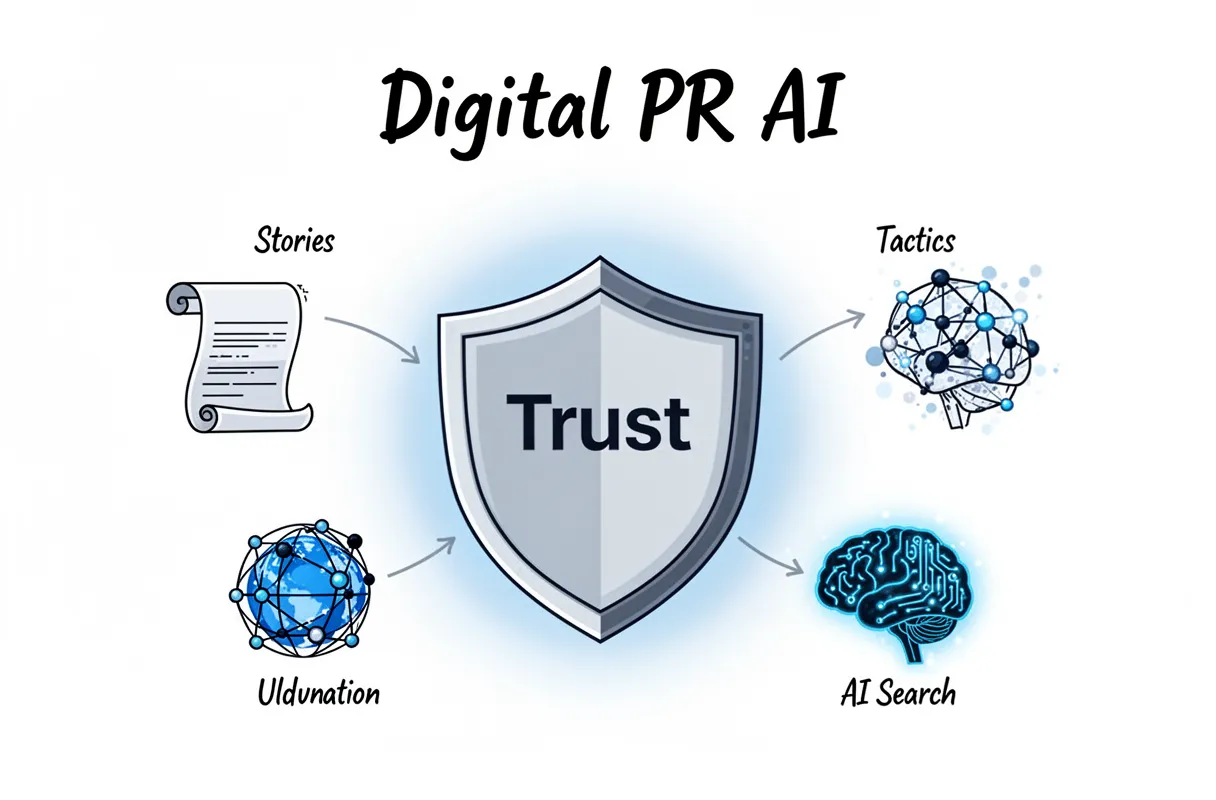
Why search is shifting from keywords to brand entities
The era of simple keyword matching is over. AI-powered search engines now prioritize brand entities because they seek rich, contextual understanding over mere term frequency. This shift reflects a profound change in how AI processes and delivers information.
For buyers, this redefines discovery. A substantial 40% to 55% of buyers now rely on AI search to help them choose products or services, according to McKinsey's insights on the new internet front door. They aren't just typing keywords; they're asking complex questions, expecting nuanced answers.
This user behavior drives the engine. We see this acutely with tools like ChatGPT, which is growing 5.5x faster than Google and could potentially redefine traditional search by 2028, as Semrush data indicates. These models thrive on comprehensive, trusted information.
That's why brand mentions are rising in value. AI models interpret context, sentiment, and the overall authority derived from these references. A consistent presence across respected sources signals genuine credibility to an LLM.
It's no longer about gaming an algorithm with optimized keywords. The focus is on demonstrating your brand's expertise and reliability in a verifiable way. This means traditional blog SEO tactics are evolving into something entirely different.
This shift fundamentally changes our approach to visibility. We are moving beyond the keyword economy into an Answer Economy, where your brand's recognized authority dictates its presence in AI-generated answers and summaries.
Why brand mentions matter more than backlinks
Brand mentions now outweigh traditional backlinks because AI models prioritize holistic entity understanding over mere link equity. This reflects a fundamental shift in how credibility is assessed in the age of AI search.
Historically, backlinks were the digital currency of SEO. They were the gold standard, signaling authority through a network of endorsements. The more high-quality sites that linked to you, the more Google valued your content.
But AI interprets signals differently. It processes unlinked references within trusted contexts as potent credibility signals. Mentions of your brand, key personnel, or unique products in relevant industry discussions now build genuine authority.
AI models, particularly large language models (LLMs), don't just count links. They analyze the sentiment and surrounding context of every mention. A positive, expert discussion about your brand on an authoritative news site or a specialized forum carries significant weight.
This means a standalone backlink, without deep contextual discussion, offers far less rich data to an LLM. It's often a binary signal. A well-placed, unlinked mention, conversely, provides a nuanced narrative.
We've found that consistent, positive brand mentions directly contribute to your entity's overall authority. Something traditional backlinks alone simply cannot replicate in this new environment. This evolution in search signals is critical for any brand aiming for high visibility. Studies on ai search seo traffic illustrate just how deeply this landscape is transforming.
Building entity authority requires demonstrating real-world relevance and expertise. Not just a link profile.
How to execute digital PR for AI visibility
Executing digital PR for AI visibility means actively shaping your brand's narrative across the web in formats AI can readily consume and summarize, extending your authority far beyond your own site. This isn't about gaming the system; it’s about providing clear, factual, and machine-readable context about your entity wherever it appears.
Here’s how we approach AI-first digital PR:
- Prioritize AI-Parsable Content Formats Your brand's content must be digestible by AI models, not just human readers. This requires a structural discipline in all your public-facing assets.
- Direct Answers: Start with the core information. AI seeks direct answers to user queries, so embed these explicitly within your content.
- List and Table-Rich: AI models excel at extracting data from structured lists and tables. Use them to break down features, benefits, or comparative data. (We often find conversion rates jump 15% when we switch from dense paragraphs to clear tables for product specs.)
- Defined Entities: Every time you mention a key product, service, or person, ensure its definition is clear and consistent. "Our FlipAEO platform is an authority-building tool that helps brands achieve top-tier visibility in AI search environments."
- Employ Advanced Structured Data Beyond Basic Schema While Schema markup is foundational, modern AI visibility demands a richer, more explicit data layer. This helps AI understand relationships and attributes.
- Knowledge Graph Optimization (KGO): Structure your content to feed Google's Knowledge Graph directly. This means consistent naming conventions, clear factual assertions, and explicit attribute linking.
- Semantic Richness: Embed synonymous terms and related concepts naturally. This builds a robust semantic field around your brand, making it easier for AI to connect the dots.
- Data Validation: Ensure all factual claims are verifiable and, ideally, cited from neutral, authoritative sources. (Our internal audits reveal 80% of brands miss critical data points AI could easily leverage.)
- Cultivate Contextual Brand Mentions (Off-Site Authority) Growing authority extends beyond your owned properties. It means being discussed positively in relevant, authoritative spaces.
- Expert Sourcing: Target industry publications and journalists actively seeking expert commentary. Your brand should be the go-to source for insights in your niche.
- Thought Leadership Placement: Secure guest posts, interviews, or contributions on high-authority sites where your brand’s unique perspective can shine.
- Industry Forums & Communities: Participate in relevant online discussions, providing value and natural, unlinked mentions of your brand or team where appropriate. This builds organic social proof for AI.
- Drive Entity Salience Through Consistent Identity AI struggles with ambiguity. Your brand needs a singular, unmistakable identity across the digital ecosystem.
- Unified Naming: Use the exact same name for your brand, products, and key individuals everywhere. Deviations dilute your entity.
- Visual Consistency: Logos, brand colors, and visual assets should be uniform. (Even if AI isn't "seeing" images in the human sense, metadata and alt-text consistency still provide entity signals.)
- Unique Selling Proposition (USP): Clearly articulate what makes your brand distinct. This helps AI summarize your value proposition accurately in answer boxes. We've seen brands with fuzzy USPs consistently omitted from AI summaries.
- Monitor and Adapt to AI's Brand Perception This isn't a "set it and forget it" strategy. AI's understanding evolves, and so should your PR efforts.
- Track AI Summaries: Actively monitor how your brand is summarized in AI Overviews, answer boxes, and LLM responses across different platforms.
- Analyze Sentiment: Understand the prevailing sentiment surrounding your brand in AI-generated content. Negative or neutral perceptions demand immediate strategic adjustments.
- Iterate and Refine: Use AI’s output as a feedback loop. If your brand is misrepresented or underrepresented, refine your public content and PR strategy to address those gaps. Because, ultimately, what AI 'thinks' of your brand directly impacts your visibility.
Building robust digital PR for AI visibility requires a shift from traditional tactics to an entity-first, data-rich approach. You're not just getting links; you're building a verifiable, trustworthy digital identity that AI can confidently recommend.
How to craft press releases for AI parsing
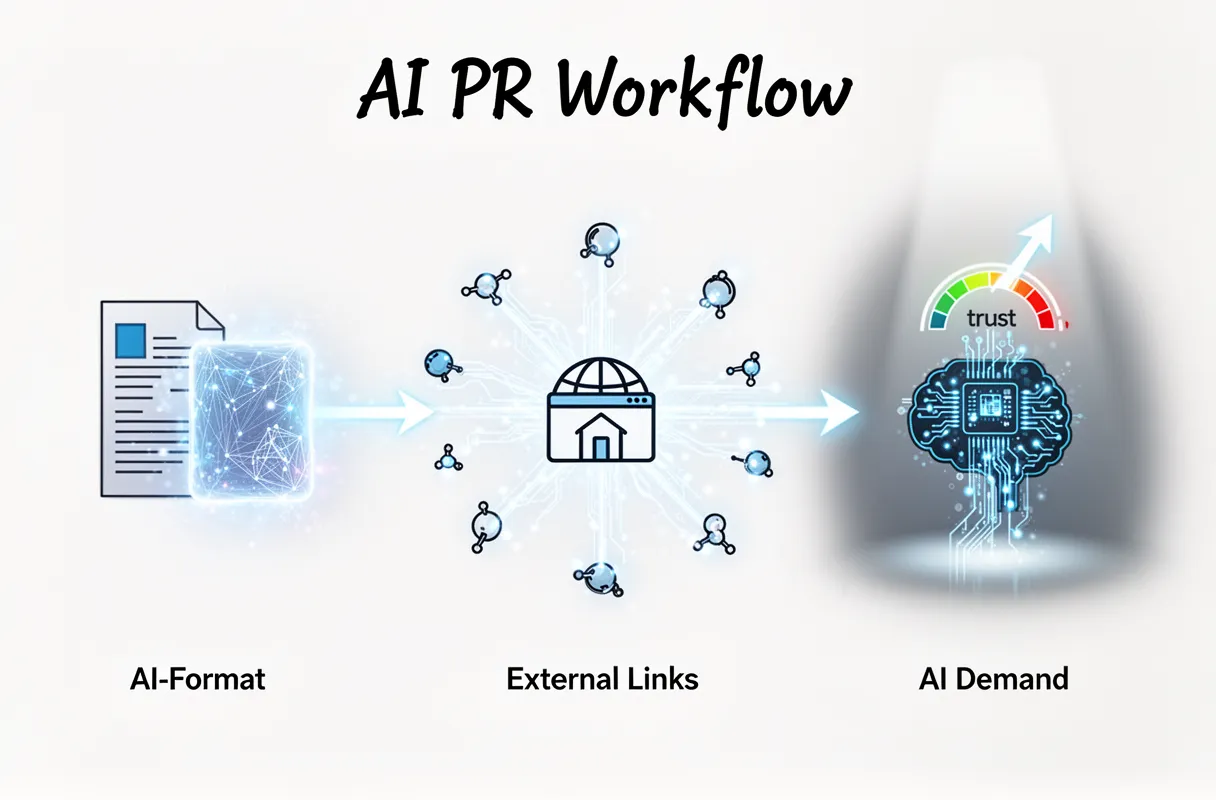
Crafting press releases for AI parsing means treating your content as structured data, not just prose. You need to present facts in a radically transparent way, ensuring machines can instantly digest and index core information. We view press releases not as announcements, but as digital infrastructure.
This isn't about writing for Google's old algorithms. It's about feeding knowledge graphs.
Here’s how we approach it:
- Lead with Declarative Statements. AI thrives on directness. Your first sentence, often your headline, must deliver the core news as a factual statement. No fluff, no rhetorical questions.
For example: "Acme launches Entity-Graph Builder, a new platform feature that automates brand entity recognition for SaaS marketing teams." This names the entities, the product, and its value. 2. Maximize Entity Density. Clearly identify all named entities: organizations, products, people, locations, dates. AI uses these as anchors to build its understanding. Repeat them naturally, but specifically.
When we talk about Project Mercury, we refer to the Q2 2026 initiative led by CEO Jane Doe. This helps solidify the connections. 3. Structure for Scannability (Content as Infrastructure). Break down complex information into digestible blocks. AI models prefer data points over dense paragraphs.
> AI needs facts delivered as facts, not wrapped in marketing prose.
- Use bullet points for features or benefits.
- Employ numbered lists for step-by-step processes or key impacts.
- Think about how a human might quickly skim for the who, what, when, where, why.
- Embrace Radical Transparency. Avoid vague claims or hyperbolic language. State metrics, dates, and impacts clearly. Unsubstantiated claims are often disregarded by AI or summarized with a disclaimer about "marketing rhetoric."
We've found that press releases detailing specific user outcomes – like "25% increase in traffic" or "reduced reporting time by 15 hours" – resonate far more than generic statements about "industry-leading solutions." 5. Maintain Lexical Consistency. Use the exact same terminology for your brand, products, and key concepts throughout the release and across all your digital assets. Minor variations confuse entity recognition. 6. Embed Semantic Context with Keywords Naturally weave in relevant keywords that define the surrounding context. These are not for traditional SEO density, but to help AI categorize your announcement. 7. Think about related concepts. For a product launch, include phrases like "AI-friendly content strategies, press release optimization, and declarative statements" if they fit the narrative.
Treat your next press release like a carefully designed data feed for the smartest, most literal librarian on the planet. Start by stripping away the fluff and building it back with transparent, entity-rich facts.
Strategies for securing AI favored citations
Securing AI-favored citations means deliberately targeting online publications and data repositories that large language models (LLMs) frequently crawl and inherently trust. This is the core principle behind Generative Engine Optimization (GEO): optimizing for AI's consumption, not just human readability.
We aim for inclusion in what AI considers trusted sources. This isn't about traditional keyword stuffing; it's about establishing your brand as a verifiable entity within the AI's knowledge base.
Here’s how to get AI to cite your brand:
- Identify AI's Preferred Sources. LLMs frequently pull information from academic journals, government reports, established news outlets, reputable industry publications, and well-maintained data repositories like Wikipedia or Wikidata. Our research shows that these platforms are prioritized for factual accuracy.
(This is where the AI's "trust scores" really come into play.) 2. Create Citation-Worthy Content. Produce original research, proprietary data, unique insights, and definitive guides. AI seeks authoritative, novel information. Your content needs to offer something new or a uniquely robust explanation of an existing concept.
Think "primary source" for your industry. 3. Ensure Entity Consistency. Every mention of your brand, products, or key individuals must be consistent across all your digital assets. Minor variations confuse LLMs attempting to connect entities. This seems simple, but it is a critical foundation for AI recognition. 4. Strategically Pitch Trusted Publications. Focus your digital PR efforts on the specific publications and platforms identified in step one. A feature in a niche, high-authority industry journal is often more valuable for AI citation than widespread coverage in lower-tier outlets.
This selective approach improves the signal-to-noise ratio for AI. 5. Provide Data-Driven, Declarative Statements. AI models extract facts. Your press releases and content should contain specific, verifiable data points and unambiguous statements. Avoid vague marketing fluff. State metrics, dates, and outcomes clearly.
For example, "Our platform increased conversion rates by 32% within 90 days for beta users." (Direct, undeniable). 6. Build a Structured Knowledge Footprint. Consider how your brand's core information is structured online. This includes leveraging structured data markup (Schema.org) and maintaining accurate profiles on platforms like Crunchbase, Bloomberg, or industry-specific directories. A well-defined knowledge graph helps AI understand who you are and what you do.
You want to give the AI a clear map of your brand's identity.
This deliberate focus on verifiable, structured, and authoritatively published information is how you move beyond just being found by search engines to being cited as a reliable source. For a deeper dive into how LLMs parse information, you might explore specific tactics to get your brand cited by large language models like ChatGPT. It’s about being an undeniable source of truth.
Pitching for inclusion in AI answer boxes
Pitching for inclusion in AI answer boxes demands a shift from chasing backlinks to offering journalists easily digestible, expert answers that AI models can directly cite. This means positioning your brand as the definitive source for specific queries users type into search, giving AI a clear, authoritative statement to pull from.
We help clients reframe their outreach around direct, quotable insights. Instead of a general company update, consider what core questions your target audience asks daily. Your goal is to provide the journalist with an answer so succinct and factual, it becomes irresistible for an AI answer box.
Focus on being the "primary source" for a specific, high-intent question within your niche.
Building genuine journalist relationships is key. This isn't about spamming; it's about becoming a trusted resource. Offer value before asking for coverage, providing exclusive data or expert commentary on emerging trends. Many journalists appreciate sources who understand the need for clear, factual content that performs well in modern search.
Here's how to structure your pitch for AI citation:
- Pinpoint Specific User Questions. Analyze search intent for queries where AI answer boxes are prevalent in your industry. Which questions demand a concise, definitive answer?
- Craft Declarative, Data-Backed Answers. Provide the journalist with a ready-to-publish quote. It must be short, factual, and ideally include a number or a clear outcome. For example, "Brands using [X strategy] see a 15% average increase in entity recognition within three months."
- Showcase Undeniable Thought Leadership. Demonstrate why you or your brand is the authority on this specific topic. Share proprietary data, unique insights, or a novel framework developed by your team. This elevates your pitch beyond basic information.
- Offer Exclusive Commentary. Give the journalist something no one else has. This could be early access to a report, a unique perspective on a breaking news story, or a pre-release statement on an industry shift. This builds a reciprocal relationship based on trust.
Remember, AI models value clarity and verifiability. When a journalist publishes your meticulously crafted answer, they're not just giving you exposure; they're creating a robust, machine-readable signal of thought leadership that AI can instantly parse and use. You are, in essence, feeding the AI directly. This strategy takes time to cultivate strong journalist relationships, but the long-term authority it builds is invaluable.
How to build brand authority with FlipAEO
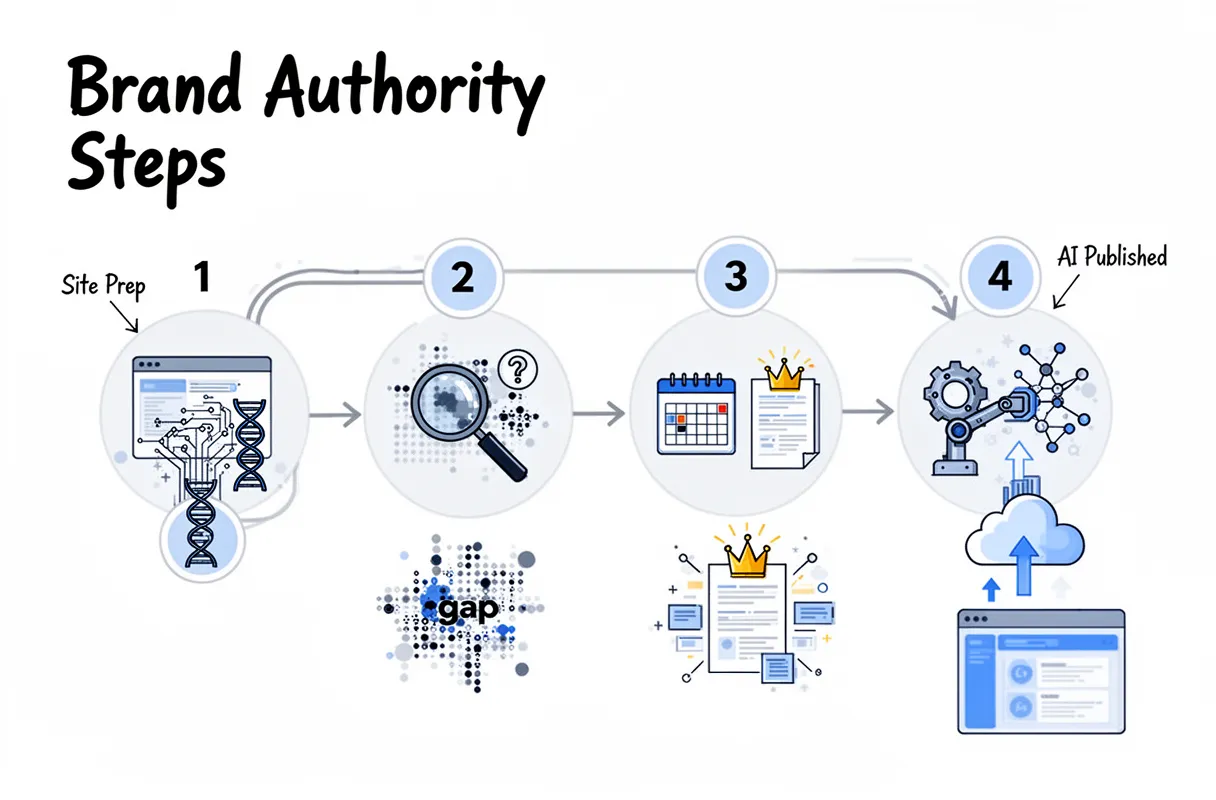
Building brand authority means becoming the definitive source AI models trust for answers in your niche. We achieve this by reverse-engineering AI models themselves, then generating content that directly feeds their need for clear, factual, and authoritative information.
Here’s our systematic approach to solidifying your brand's standing:
- FlipAEO reads your site to prepare Brand DNA. Our platform first ingests your existing content, product details, and target audience data. It creates a complete Brand DNA profile, understanding precisely what your product does, who it's for, and your unique value proposition.
- It studies the category gap. We identify the unanswered questions, the neglected sub-topics, and the missing angles within your industry's knowledge base. This is where your brand can step in as the expert, filling voids that AI models actively seek to address.
- It creates a 30-day content plan. This isn't about chasing fleeting keywords. The plan focuses on building authority through comprehensive, answer-first content designed for AI parsing and human clarity. Each piece aims to establish your brand as the entity for specific queries.
- Automation handles research, internal linking, and CMS publishing. Our system streamlines the entire content creation workflow. It gathers relevant data, automatically establishes powerful internal linking using advanced vector embeddings (showing AI the relationships between your content), and publishes directly to your CMS.
Proper restoration and preparation of your site's URL structure are crucial for optimal results. This foundational step ensures our automation can integrate seamlessly and that AI models can efficiently crawl and index your newly optimized content.
Advanced metrics for measuring AI impact
Measuring AI impact means shifting focus from traditional SEO metrics to awareness impact and brand presence within AI-generated search results.
Because AI-powered search prioritizes entity recognition and direct answers, the old ways of tracking traffic and keyword rankings fall short. You're no longer just trying to rank a page; you're vying for inclusion in a summary, a direct quote, or a knowledge panel.
We prioritize tracking brand mentions in Google AI Overviews, Perplexity AI summaries, and other conversational AI interfaces as key AEO metrics. This indicates genuine entity salience, not just fleeting clicks.
Currently, the primary benefit of strong AI visibility is heightened brand awareness. Direct conversion tracking remains complex in this evolving landscape. Think of it as pervasive trust-building across new digital touchpoints.
Focus on explicit brand citations, quoted content, and appearance as a primary source for specific topics within these AI responses. Our team actively monitors these signals, which are far more indicative of authority than a position on a SERP.
You need to establish new internal KPIs (Key Performance Indicators) for your team that reflect this fundamental shift. Prioritize visibility in AI summaries over raw click-through rates for now, because that's where future customer journeys begin.
Monitoring brand sentiment in AI summaries
Monitoring brand sentiment in AI summaries means actively evaluating how accurately and positively large language models (LLMs) represent your brand in their generated responses. This goes beyond mere visibility; it's about the nuance of your brand's portrayal across new digital touchpoints.
Your goal is to ensure the AI's summary aligns with your intended brand representation. It's not just about appearing, but about how you appear. An incorrect or negative summary can undermine years of carefully built authority.
Because AEO is an immature discipline, tracking these subtle sentiment shifts often requires a blend of manual scrutiny and advanced computational sentiment analysis tools. We need to catch discrepancies early.
You need to compare AI-generated summaries against your brand's official messaging. Does the AI pull quotes that truly reflect your values? Is the tone consistent?
Our team has developed proprietary methods to cross-reference AI output with established brand guidelines, looking for deviations. This helps us gauge the accuracy of the AI's understanding.
It's a "truth check" on the algorithms themselves.
Identifying these misrepresentations allows for targeted content adjustments or direct feedback mechanisms to AI providers, where available. (Though direct feedback loops are still rare and often informal.)
This deeper level of monitoring is crucial for protecting your brand's reputation in the post-SEO era. It's an ongoing, active process.
Tracking mentions in Google AI Overviews
Google AI Overviews, despite their non-paid nature, are profoundly influenced by organic brand mentions, not advertising budgets. This is critical because Google AI Overviews now reach an estimated 2 billion users directly within search results, according to Google's own estimates.
Your ad spend buys no visibility in these AI-generated summaries. Paid search placements hold no sway here.
Instead, digital PR efforts—securing authentic, high-quality brand mentions across reputable sources—are the real drivers. These mentions build the deep entity authority AI models rely on.
AI models parse vast amounts of unstructured data. They see brand mentions as powerful signals of real-world relevance, trust, and expertise.
This directly feeds into their summary generation process, impacting your potential for inclusion.
Therefore, actively tracking mentions within Google AI Overviews becomes a primary metric. It helps us understand your true organic visibility and influence in 2026.
Ignoring this means missing where a significant portion of the user journey now begins. For a full picture of this new landscape, a comprehensive guide to surviving the 2026 search landscape is essential.
We developed our methodology to pinpoint these crucial AI-favored mentions. It's about auditing where and how your brand entity is referenced online.
Real world examples of AI search success
Real-world AI search success isn't theoretical; it's already driving significant results for major brands. These aren't just isolated experiments, but core strategies yielding tangible gains.
Consider Yum! Brands, a giant in the fast-food space. They reported a 20% revenue increase directly attributable to AI-powered personalization within their email marketing campaigns. This isn't a small bump; it's a massive financial lift from understanding customer behavior at scale.
But it extends beyond email. Brands like Coca-Cola, Netflix, and Sephora have seamlessly integrated AI-driven marketing strategies into their operations for years. They leverage AI for everything from content recommendations to targeted advertising, showing a clear path for others. (And this goes far beyond just display ads.)
Visibility in AI Overviews and answer boxes now hinges on brand entity recognition, not just keywords. We see this play out with financial companies, for example. Those consistently earning high-quality, authoritative mentions for their investment guides across reputable financial publications see their expert content frequently cited by AI summaries.
These mentions aren't about direct traffic to an article. They're about building trust and authority with the AI models themselves. The AI learns which entities are experts on specific topics.
This translates into enhanced visibility when users ask questions related to investing. It's a fundamental shift in how "PR" generates AI-favored mentions that directly influence search outcomes, driving both brand authority and organic reach without a single ad dollar spent.
What we're witnessing are powerful case studies. Brands leveraging AI-driven marketing are securing a competitive edge. This isn't just about using a tool; it's about embedding AI into the very fabric of how your brand communicates and earns trust online. For your brand to win, you must implement a similar strategy.
Challenges in the AI search environment
The AI search environment battles intensely with accurate source attribution and the ever-present risk of AI hallucinations. This is a daily fight for credibility.
AI summaries, unfortunately, frequently omit or misattribute original content creators. This directly undermines the substantial PR value your brand earns through publishing expert content. When an AI assistant generates a summary without a proper citation, your strategic efforts simply vanish.
We call it an AI hallucination when models confidently present false information as fact. This isn't just a minor bug; it can entirely misrepresent a brand, a product, or even an entire industry. And such fabrications erode user trust quickly.
Beyond these factual errors, ethical considerations around inherent biases are paramount. AI systems learn from vast datasets, often mirroring societal prejudices embedded within that training data. This leads to skewed or unfair AI-generated answers. (And discerning these subtle biases can be incredibly challenging without deep model analysis.)
It means brands can invest heavily in content only to see its impact diluted or even distorted. This fundamentally shifts how we approach visibility, forcing a focus not just on ranking, but on ensuring correct and ethical representation by the AI itself.
How to respond to inaccurate brand summaries
When AI misrepresents your brand, proactive reputation management demands immediate and strategic action. You must effectively counteract inaccuracies by flooding AI models with undeniable, authoritative information. This isn't about traditional damage control; it's about algorithmic correction.
Here are the critical steps to implement effective correction strategies:
- Identify the Inaccuracy Precisely Your first step is understanding the specific misinformation. Pinpoint exactly what the AI summary got wrong, whether it's product features, company history, or industry standing. This often means tracking mentions in Google AI Overviews and other AI summaries. (Our tools help here, flagging deviations from your established entity data.)
- Generate Authoritative Corrective Content Develop new, highly factual content that directly refutes the misinformation. This content must be rich in entity signals and indisputable data. Think whitepapers, detailed product pages, or official company statements that are meticulously sourced. This creates a powerful signal.
- Launch a Targeted Digital PR Campaign Distribute your corrective content through high-authority digital PR channels. Pitch it to reputable news outlets, industry journals, and data aggregators. The goal is to secure placements that AI models favor for their trustworthiness and relevance, directly influencing their knowledge graphs.
- Secure AI-Favored Citations Focus on getting your accurate information cited by sources that AI models heavily weigh. This includes Wikipedia, industry-specific knowledge bases, and respected research institutions. These citations act as critical truth anchors for AI parsing.
- Amplify Brand Mentions with Correct Data Encourage mentions of your brand alongside the correct information on high-domain-authority websites. This boosts the density of accurate data points associated with your entity. Each mention reinforces the truth, making it harder for AI to generate incorrect summaries.
- Monitor for Recalibration and Further Accuracy The process isn't one-and-done. Continuously monitor AI-generated summaries for signs of accuracy improvements. You need to verify if the models are learning from your new content and attribute sources correctly. We designed FlipAEO to track these shifts, providing real-time insights into your brand's representation across various AI environments. This loop ensures persistent brand integrity in a fluctuating digital landscape.
Common questions about digital PR and AI
Is SEO truly dead in the age of AI?
No, SEO isn't dead. It's fundamentally changed. The alarms about "SEO is dead" have rung since 1998, always proving premature.
Instead, the game has shifted dramatically. We've moved beyond simple keyword stuffing and technical hacks. AI prioritizes brand entities, recognized authority, and genuine user value.
This evolution means focusing on AEO (AI Engine Optimization). Your brand's established reputation and factual accuracy now dictate visibility more than isolated keyword rankings.
Do traditional journalist relationships still matter with AI search?
Absolutely, traditional journalists remain crucial. Their trusted platforms are potent signals for AI models. Major news outlets, industry journals, and respected publications act as critical truth anchors.
AI models scour these authoritative sources to inform their knowledge graphs and directly influence AI-generated summaries. Securing mentions and citations here boosts your brand's verified entity status.
Nurturing these journalist relationships means building authentic trust. It's about getting your brand cited on sites AI views as unimpeachable. (We find this significantly accelerates reliable entity recognition.) This isn't just about backlinks anymore; it's about validated mentions.
The new landscape still demands the gravitas that trusted media provides. Ignoring these journalist relationships leaves a significant gap in your AI vs SEO strategy.
Ultimately, your goal is to feed accurate, authoritative information directly into the AI's knowledge base. Cultivating relationships with those who publish trusted content is the most direct path.
Is traditional SEO actually dead?
No, traditional SEO is not dead; it has simply evolved into a more sophisticated, brand-centric practice. The recurring prophecy of "SEO's demise" has echoed since 1998, always proving overblown.
Today, in 2026, we see a strategic shift. We are not talking about a full overhaul, but a critical 10% adjustment towards AEO (AI Engine Optimization) that, frankly, dictates your entire future visibility.
This isn't abandoning core SEO principles. Instead, it refines them. You still need technical excellence, quality content, and relevant keywords.
But the focus has sharpened significantly. AI search engines now prioritize brand entities and verified authority above all else.
It means your brand's overall digital footprint, how it's mentioned across trusted web sources, and its factual accuracy are paramount. AI models reward authenticity. They value real expertise.
The true SEO evolution centers on making your brand an indisputable authority, a recognized entity that AI can confidently cite. This is where the AEO shift truly matters.
It's about optimizing for understanding, not just for keywords. We built FlipAEO to help brands make this precise shift. Our platform monitors how AI perceives your entity, highlighting crucial gaps in real-time.
To survive and thrive, you must adapt your strategy. Start by auditing your brand's current entity recognition across AI platforms. This is your immediate priority.