
Brand citations are explicit or implicit mentions of your brand across the web that AI-powered search engines use to establish authority, relevance, and credibility. They signal trustworthiness to Large Language Models (LLMs), influencing their answers and recommendations more profoundly than traditional backlinks ever could. This is the new currency.
Core Components:
- Primary Goal: Establish AI-driven trust and visibility.
- Key Mechanism: Unstructured mentions and structured data.
- Influence: Directly shapes generative AI outputs.
- Paradigm Shift: Moves beyond link-centric SEO.
Forget the old playbook of chasing backlinks. As of February 2026, over 60% of searches now generate AI-powered answers, often without a single click to a website. Links were the currency of the old web; citations are the undeniable currency of the AI web. This isn’t just a trend; it’s how AI decides who matters.
People often ask if this shift truly impacts their existing content. It does. Your brand needs to be citable, not just found. This mirrors a much older principle: differentiating your mark. Since the 1500s, livestock owners used unique marks to identify their cattle – the core concept of branding. Today, that need for unique differentiation has simply evolved into a demand for consistent, attributable digital mentions.
By the end of this guide, you will understand how to systematically increase your brand citations and gain unparalleled AI visibility, without relying on outdated SEO tactics or generic, unproven AI tools. We will show you exactly how.
Why brand citations are the new backlinks
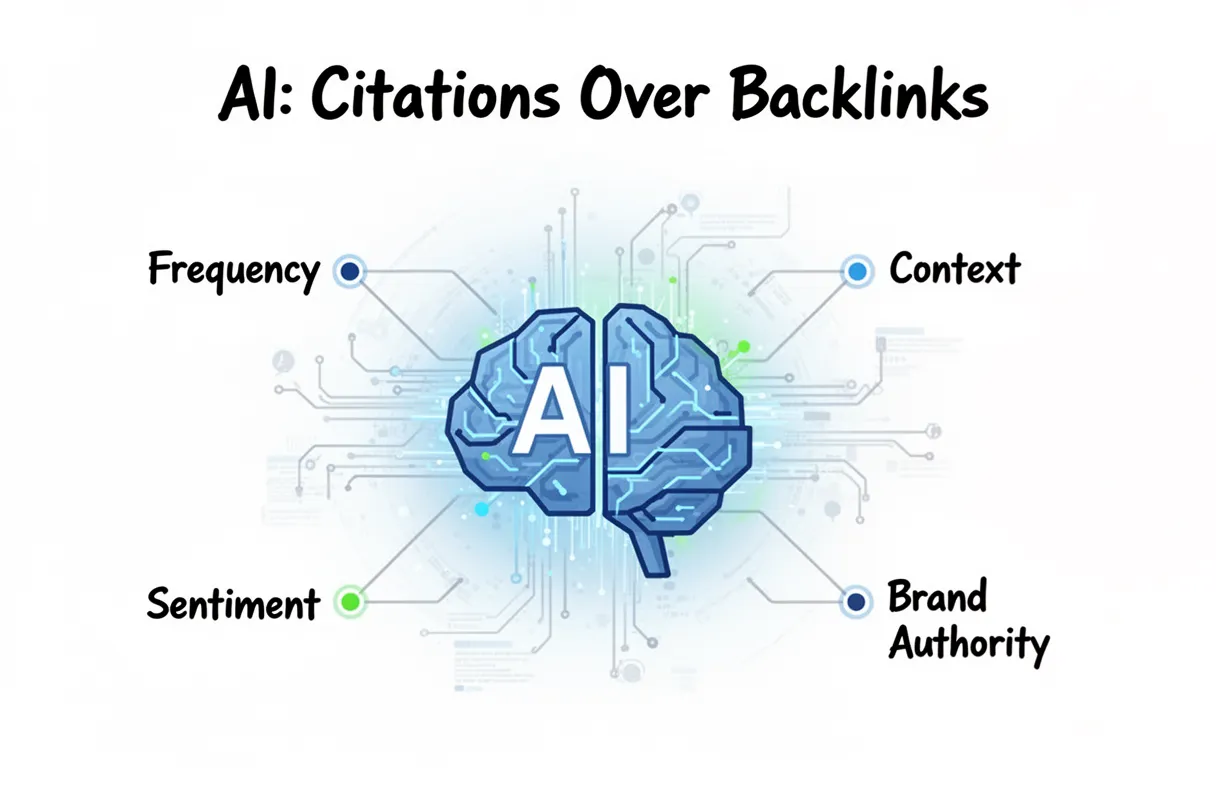
Brand citations are the new backlinks because Large Language Models (LLMs) prioritize a brand’s holistic digital reputation over individual link signals. Links were merely a vote; citations build a pervasive, contextual understanding of your brand across the web.
This is a fundamental shift towards Search Everywhere Optimization. Your brand needs to exist and be acknowledged wherever potential customers might ask an AI for answers, not just on a traditional search results page.
LLMs are trained on billions of parameters, ingesting vast amounts of text from diverse sources. They don’t just count incoming links; they analyze the frequency and context of every single brand mention.
For AI, reputation and surrounding context are far more significant than a simple hyperlink. When your brand is consistently discussed in authoritative, relevant contexts, AI begins to view it as a credible, established entity.
This explains why LLMs prioritize the context of brand mentions over simple keyword matches. It’s why understanding entity density matters more than ever in the AI era.
A single link offers minimal semantic data. But a nuanced discussion about your product or service, even without a direct link, signals genuine authority. (This also applies to negative mentions, so monitoring is key).
We see this in generative AI results. A high volume of relevant, positive brand mentions in diverse contexts directly influences whether an LLM will recommend your brand. This isn’t theoretical; it’s how AI decides who truly matters.
What counts as a brand citation in 2026
A brand citation is any discernible occurrence of your brand’s name, logo, or unique identifiers across text, video, or structured data, providing clear context to an AI engine. It’s more than a mere mention; it actively builds your brand equity within the digital landscape.
Unlike a fleeting mention, a true citation carries weight. It affirms your presence within a specific digital context, contributing to how AI understands your authority. And it’s fundamentally different from a technical backlink, which is merely a pointer.
AI models parse surrounding unstructured data—the words, phrases, and sentiment associated with your brand’s identifier. This includes mentions within articles, forum discussions, social media posts, or even spoken word in transcribed podcasts and videos.
Crucially, it also encompasses structured data like schema markup, knowledge panel entries, or brand listings. These explicit signals tell AI precisely what your brand offers, your target audience, and the problems you solve.
Research shows why brand mentions now function as a critical currency for online visibility. Any instance where your brand contributes to the digital conversation, whether directly linked or not, actively counts. It’s about the entire digital context an AI builds around your identity.
How frequency and context shape AI answers
AI answers prioritize brands that are both frequently and contextually linked to specific solutions. Large Language Models (LLMs) parse the web to understand these relationships, building a semantic alignment between problems and the entities that solve them.
When your brand name consistently appears alongside solution-oriented keywords, AI recognizes the pattern. For instance, if your brand is repeatedly mentioned near phrases like “improve content visibility” or “solve AI search ranking,” a strong association forms.
This direct, repeated connection significantly increases the likelihood of your brand appearing in AI overview content. The LLM learns to recommend your brand as a credible answer when users query those specific problems.
It’s not about keyword density alone. It’s about the proximity and natural fit of your brand within a solution-driven narrative. The closer your brand is to the problem and its resolution, the stronger the signal.
We’ve observed this with our clients. Brands with a high volume of relevant, solution-focused mentions see AI citations grow significantly faster. This moves them from generic search results to direct AI recommendations.
Consider how a human recommends a product. They recall frequent positive experiences or mentions. LLMs operate similarly, but across billions of data points. They map brand identities to user needs.
This contextual reinforcement builds a robust “digital knowledge graph” around your brand. It moves beyond simple awareness to established authority within AI’s understanding. And that’s exactly what drives visibility in 2026.
How to increase brand citations with FlipAEO
Increasing brand citations requires a targeted strategy, not just more content. Our FlipAEO platform directly addresses this by engineering your content for AI visibility from the ground up. We move past generic advice to build your brand’s authority, precisely where LLMs look for answers.
Here’s how we help you generate impactful brand citations:
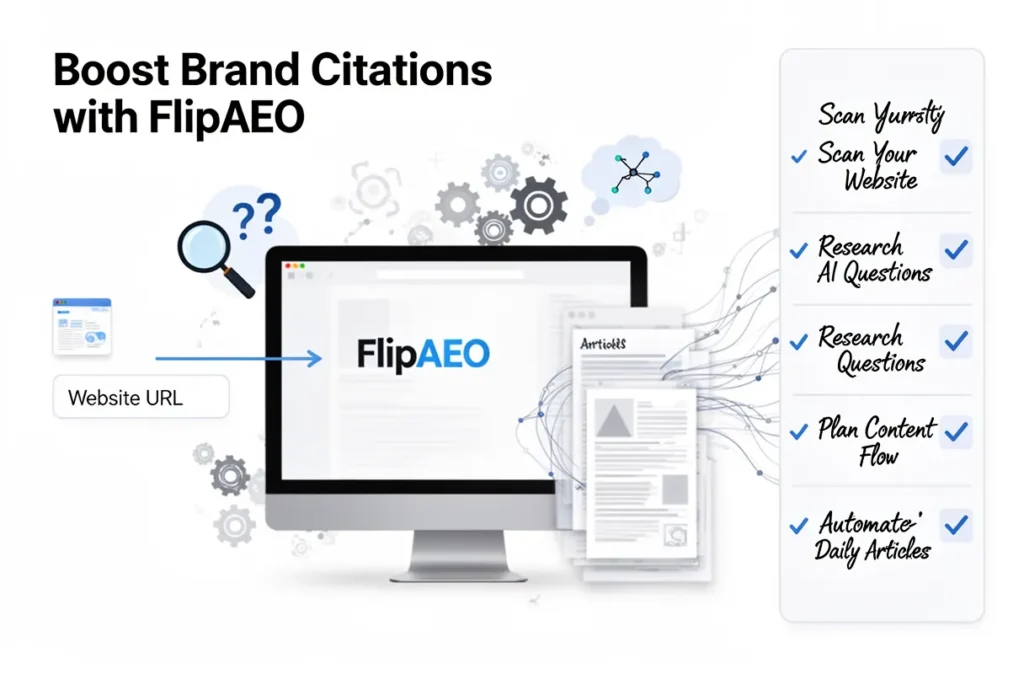
- Define Your Brand DNA: We start with your website URL. FlipAEO ingests your existing site to understand your core product or service, its unique value proposition, and your ideal customer. This foundational step builds your Brand DNA, creating a precise digital profile of who you are and what you solve.
- Category Mapping & AI Gap Analysis: The platform then maps your entire category. It identifies existing conversations, scrutinizes competitor content, and—crucially—pinpoints what questions AI models are currently answering, and where the gaps lie. We find the specific information LLMs are missing, or misinterpreting.
- Strategic Content Planning: Based on the AI gap analysis, FlipAEO outlines content themes. We plan articles around distinct, unanswered questions, ensuring a logical flow that systematically builds category authority for your brand. This isn’t just about keywords; it’s about owning the semantic space.
- Automated, Research-Backed Content Generation: Our system automates the creation of one research-backed article per day. Each piece is designed for maximum citation potential, incorporating smart internal and external linking strategies. This consistently positions your brand as a leading source.
For the best results, a clear Unique Value Proposition (UVP), already hinted at or explicitly stated on your existing site, significantly accelerates this process. It gives FlipAEO a sharper focus for your Brand DNA analysis. We then leverage that clarity to sculpt content that AI models can’t ignore.
Why building brand DNA comes before writing
Building your brand’s unique Brand DNA must precede any content creation because generic AI writers often fail to capture the nuanced market context required for true authority, instead focusing on keywords rather than the complete semantic space. Many tools simply chase high-volume terms.
This keyword-first approach is a fundamental flaw. It produces content that sounds hollow, lacks depth, and struggles to establish genuine brand positioning in the minds of both humans and AI models. LLMs don’t just look for isolated keywords. They understand entities, relationships, and context.
Without a defined Brand DNA, your content risks becoming generic. It gets mistaken for other sources, or worse, offers inaccurate interpretations of your unique value. This leads to what we call “thin content” by AI standards, regardless of word count.
Our approach differs. We start by ingesting your existing site, meticulously analyzing your products, services, and ideal customer. This process builds a precise digital profile—your Brand DNA. It maps your entire category.
This mapping reveals where conversations exist, scrutinizes competitor narratives, and most importantly, identifies what specific questions AI models are already answering, and where the critical information gaps lie. We don’t just target high-volume terms. We identify the precise semantic space your brand can own.
This foundational work then informs truly strategic content. We craft articles designed to fill those identified gaps, establishing your brand as a primary source of truth within your niche. It’s about building authority that LLMs recognize and cite.
Generic AI writers churn out volume, but without this core understanding of Brand DNA, it’s just noise. They produce content that might hit a keyword, but it rarely earns a citation. We focus on content that deserves to be cited because it answers specific, often overlooked, questions with unique, authoritative insight.
You need to establish your intellectual property in the digital sphere, not just echo what’s already out there. Define your brand’s unique contribution first. Then, write.
Optimization tactics that make content citable
Optimizing content for AI citation means structuring it for rapid machine comprehension and guaranteeing technical accessibility. You need to present information in ways AI models can easily parse, understand, and then reference.
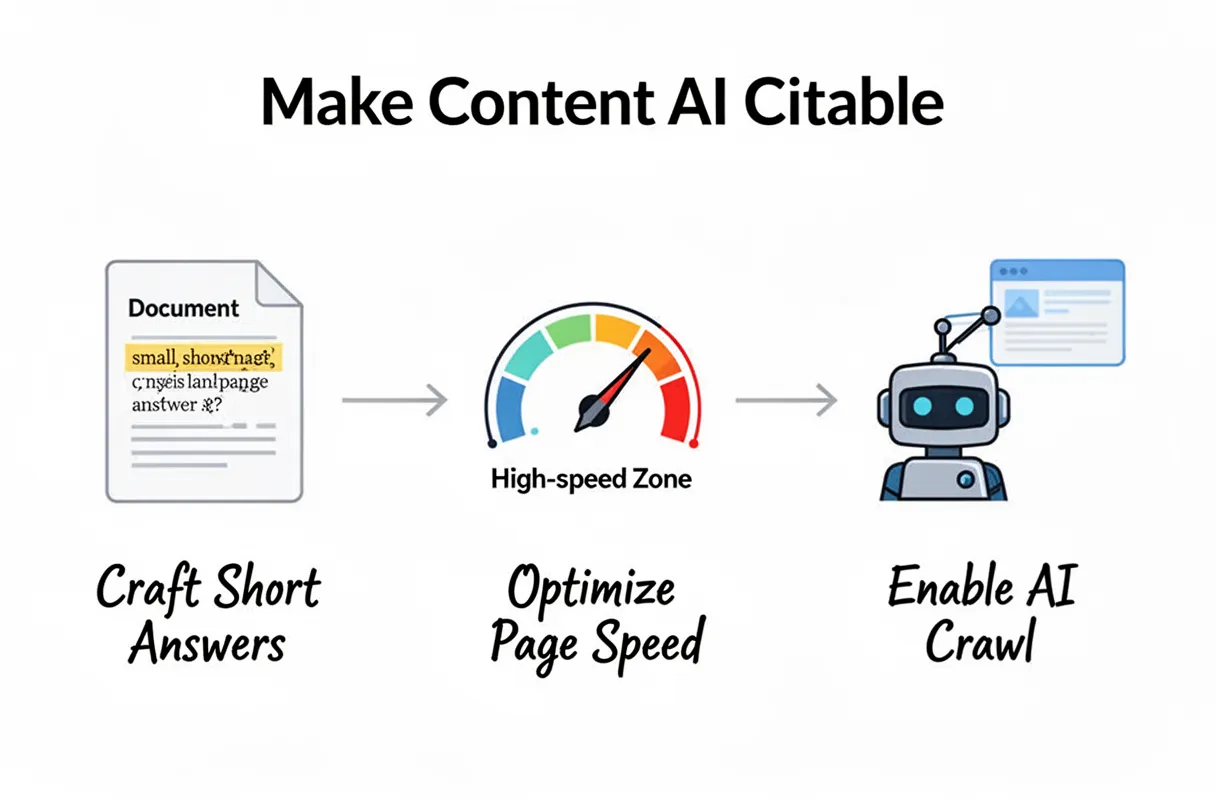
This starts with answer-first content. AI models prioritize direct answers that resolve user queries quickly. For featured snippets or AEO responses, content optimization should favor short, definitive answers of maximum 350 characters. It makes it easy for AI to “lift” your precise statement.
Heading structures are critical. Use H2, H3, and H4 tags logically. This signals a clear hierarchy to AI crawlers, helping them map the semantic relationships within your content. Each heading should introduce a distinct, answerable sub-topic.
Beyond structure, technical performance matters significantly. AI crawlers need to access your content efficiently. We see successful citation rates correlate directly with high site speed, specifically achieving 65+ on mobile and 85+ on desktop for Core Web Vitals. Slow sites introduce friction, impacting crawlability and indexation.
Implement FAQ sections using a dedicated heading, like an H3 for “Common Questions.” Present each question followed by a concise, standalone answer. This trains the AI on specific Q&A pairs, making your content a prime candidate for direct answers in AI search results.
And, you need to ensure every piece of content speaks directly to your established Brand DNA. This deep alignment requires a comprehensive technical framework for answer engine optimization. Otherwise, your perfectly structured answers might still be attributed to a generic source.
We prioritize these structural and performance details. Our platform flags content that struggles with clarity for AI models, offering specific suggestions for snippet optimization. You can have the best answers, but if the AI can’t read them quickly or understand their hierarchy, they remain invisible.
Next, audit your existing content for these specific structural weaknesses. Identify pages that rank but don’t capture snippets. Then, re-engineer them to prioritize direct, clear answers.
Standardizing your information with schema markup
Schema markup directly standardizes your content for AI, providing unambiguous data points. This metadata tells search engines and large language models (LLMs) precisely what your content means, not just what it says. Without it, even perfectly optimized text remains open to misinterpretation.
Implementing key schema types ensures AI systems parse your information with maximum accuracy. We prioritize Product, Organization, and PriceSpecification schema. Each serves a distinct purpose in defining your brand’s digital identity.
Organization Schema: Your Brand’s Digital ID Card
Organization schema explicitly defines your entity to the web. It’s the digital ID card for your brand, establishing who you are and what you represent. This is fundamental for E-E-A-T (Experience, Expertise, Authoritativeness, Trustworthiness) signals.
This schema includes essential details like your official name, logo, website URL, and contact information. It tells AI, “This content originates from this specific, verifiable entity.” Accuracy here prevents misattribution.
Product Schema: Detailing Your Offerings
Product schema provides granular details about every product or service you offer. It moves beyond simple descriptions, giving AI a structured view of your inventory. This is how LLMs understand specific features and availability.
You use it to specify product names, unique identifiers (SKUs), comprehensive descriptions, and images. It’s crucial for answers to direct product queries. Without it, AI might struggle to match specific user needs to your offerings.
PriceSpecification Schema: Clarity on Costs
PriceSpecification schema often nests within Product or Service schema, providing explicit pricing details. It clarifies costs, currencies, and any conditions tied to a price. Ambiguity around pricing is a common reason for overlooked citations.
This schema identifies the actual price, the currency (e.g., USD, EUR), and the price type (e.g., “minimum” or “fixed”). It ensures AI can directly answer “How much does [product] cost?” without guesswork.
These structured formats are non-negotiable for modern AEO. They act as a Rosetta Stone, translating your human-readable content into machine-readable data. Our clients consistently find that robust schema implementation dramatically increases their content’s citability. It cuts through the noise.
You should immediately audit your existing content for schema gaps. Prioritize applying Organization, Product, and PriceSpecification markup to your core pages.
Methods to secure proactive mentions
Proactive mentions aren’t about waiting for AI to stumble upon your brand. You actively build the pathways. This means engaging in Digital PR and forging influencer partnerships.
We consistently pursue earned media by engaging journalists directly. However, it is widely observed across the industry that journalists rarely notify brands when a story goes live. This necessitates active monitoring to capture every mention.
This is exactly why influencer partnerships are so powerful. Working with creators on platforms like YouTube or Reddit generates authentic reviews and discussions. These aren’t just promotional content.
They become diverse citation types that modern LLMs ingest. Think genuine product walkthroughs, candid user experiences, or deep-dive discussions on a relevant subreddit.
Such collaborations build profound brand authority far beyond your owned channels. They demonstrate real-world product usage and provide third-party validation. And that resonates powerfully with both human audiences and sophisticated AI models.
To truly secure these mentions, map out your target publications and key influencers. Then craft pitches that offer genuine value, not just a product plug.
It’s not about a generic press release distribution. It’s about a consistent, strategic outreach effort. This ensures your brand is not just mentioned, but cited within relevant, high-authority contexts.
Turning unlinked brand mentions into citations
Turning unlinked brand mentions into full-fledged citations immediately boosts your content’s authority and SEO value. This means actively finding every instance where your brand is named on a third-party site without a direct link back to you.
Finding these mentions requires persistent monitoring. We leverage advanced tools that scan the web for our brand name, or specific product names, even without an accompanying hyperlink. Tools like Brandwatch, Ahrefs’ Content Explorer, or even Google Alerts (for basic coverage) are essential starting points. (Yes, sometimes the old tools still have their place.)
But the real work begins after detection. Each unlinked mention represents a missed opportunity for link reclamation. A mention is good, but a contextualized link is far better for search algorithms.
Link reclamation is the process of identifying unlinked mentions of your brand or content and reaching out to the referring site’s editor or webmaster to request a direct link. This directly impacts your citation value.
We prioritize outreach to high-authority domains. A mention on a niche blog is valuable, but a link from an established industry publication carries significantly more weight with AI search engines. (It signals stronger trust.)
When we reach out, the goal isn’t just any link. We explain why their audience would benefit from a direct source. Our approach often involves this sequence:
- Acknowledge the mention: Start by thanking them for featuring our brand.
- Provide context: Gently explain that adding a link would enhance the reader experience.
- Suggest a specific anchor: We recommend a natural, relevant phrase within their text for the link.
Subject: Quick Thank You + Small Suggestion for Your Article on [Topic]

Hi [Editor Name],

Just read your piece "[Article Title]" on [Website Name] – fantastic insights into [Topic]! We especially appreciated your mention of [Your Brand Name].

We believe your readers would find it even more valuable if they could easily jump to our [Relevant Page/Resource]. Would you consider adding a link from "[Mentioned Phrase]" to [Your URL]?

Thanks again for the great work.

Best,
[Your Name/Team]
This direct, value-driven pitch dramatically increases our success rate. It’s not about demanding; it’s about mutual benefit.
Because an unlinked mention is just noise until it’s converted. That conversion makes the difference between being vaguely known and truly cited.
Your next step: Start an immediate audit for your own unlinked mentions. Prioritize the ones on high-authority sites. Then, craft those outreach emails.
Leveraging social listening for brand monitoring
Social listening uncovers hidden citation chances by tracking what’s said about your brand and industry. This ongoing process helps identify overlooked mentions across the digital sphere, giving you an edge in AI search. It is about actively seeking out those conversations.
Social listening is the monitoring of digital conversations to determine consumer sentiment that helps brands understand public perception and find mentions. AI search models prioritize relevancy and authority. Unlinked brand mentions serve as crucial signals.
Think of an unlinked mention as a whisper. It indicates influence and recognition. But unless you’re listening, you will miss it.
Knowing where these conversations occur is key. Not every platform holds equal weight for every brand. We look for these signals across varied digital spaces, tailoring our approach. For instance, Octolens helps us scan professional networks like LinkedIn and critical podcast transcripts. This catches executive-level discussions and thought leadership mentions.
For community-driven platforms like Reddit, where authentic discussions thrive, KeyMentions is invaluable. It flags direct brand references within niche subreddits. And for visual platforms, monitoring YouTube with Brandwatch reveals product reviews, tutorials, and user-generated content. These are powerful sources for potential citations.
But identifying mentions is only the initial step. These brand monitoring tools provide the “what” and “where” of a conversation. They don’t handle the “how” of conversion. We leverage their insights to fuel our targeted outreach efforts. We transform a casual mention into a formal, value-driven citation.
Ignoring social listening means missing out on legitimate search authority. You won’t know who is talking about your brand or product. And you certainly won’t convert those mentions into powerful algorithmic signals.
Start by defining your brand’s core keywords. Investigate where those discussions naturally occur, then choose the right brand monitoring tools to begin actively listening.
Tracking a brand citation manual method
Tracking brand citations doesn’t always require sophisticated software. You can leverage Google News for a basic, manual approach to spot recent mentions of your brand. This method helps you stay informed even without a dedicated monitoring platform.
Here’s how to set up your own scrappy monitoring system:
- Navigate to news.google.com. This is your starting point for real-time news aggregation.
- Enter your brand name or key product terms into the search bar. Use exact phrases in quotes for precision (e.g., “FlipAEO platform”).
- Click the Tools tab directly below the search bar. This reveals filtering options.
- Under “Sort by relevance,” change it to Sort by date.
- Now, set your desired timeframe. Options like “Past hour,” “24 hours,” or “Past week” are ideal for manual brand monitoring.
This quick scan helps you identify immediate news, press releases, or articles featuring your brand. It’s a snapshot, useful for gauging immediate sentiment. But you need to do it consistently.
While effective for quick checks, this Google News tracking method has limitations. It won’t catch discussions on forums, social media, or niche blogs. Those platforms require the specialized listening tools we discussed previously.
You are limited to public news sources. The real depth often lives in conversations not indexed by Google News. So, while it’s a good start, remember it’s not a complete picture.
Make checking Google News a daily habit. Consistent effort is key to catching those early mentions and understanding where your brand appears across the web.
Metrics that actually matter for ROI
Measuring the true impact of brand citations goes beyond simple traffic numbers; it demands tracking Answer Engine Share of Voice (AESOV) and Sentiment Trends. These Key Performance Indicators reveal how effectively your brand influences AI-generated content and shapes public perception.
Traditional metrics miss the nuance of how AI processes information. You need to understand your presence in the answers themselves, not just the search results.
Moving Beyond Basic Traffic: Advanced KPIs
Focusing solely on website visits from citations is a narrow view. The real ROI from brand citations stems from deep brand integration into AI’s understanding of a topic.
This requires a shift in how you define success. We track specific signals.
Answer Engine Share of Voice (AESOV)
Answer Engine Share of Voice quantifies your brand’s presence in direct answers provided by AI search experiences like Google SGE or Perplexity. It’s not about ranking position, but citation frequency and prominence within generated responses.
A higher AESOV means AI models frequently cite your brand as a relevant authority. This directly builds brand equity in the AI era.
Sentiment Trends in AI Summaries
It’s not enough to simply be mentioned. The context and tone of those mentions are everything. Sentiment Trends analyze whether AI summaries and answers portray your brand positively, negatively, or neutrally.
Monitoring this helps you course-correct messaging or address emerging brand perception issues immediately. A consistent positive sentiment across AI answers reinforces trust.
Citation Quality Score
Every citation isn’t equal. A Citation Quality Score factors in the authority of the citing source, the relevance of the context, and the sentiment.
We developed this internally. Our system prioritizes mentions from industry-leading publications or established experts over fleeting forum discussions.
AI Referral Traffic & Conversion
While not the only metric, tracking AI referral traffic remains crucial. It shows a direct path from an AI-generated answer to your site. This allows us to quantify the immediate user action.
But the real insight comes from analyzing conversion rates of this specific traffic segment. Users arriving from AI often have high intent. For effectively measuring the impact of AI-driven citations on your traffic, understanding specific attribution models is key. This is why we created a guide for tracking ai referral traffic guide to bridge this measurement gap.
This traffic isn’t just about volume. It’s about qualified leads.
The Next Step: Consolidate Your Data
Manually tracking these metrics is nearly impossible at scale. You need a centralized system that aggregates data from various sources: news aggregators, social listening tools, and direct AI answer monitoring.
This isn’t about more data. It’s about smarter data. You need insights that directly inform your content strategy and resource allocation.
Evaluating the quality of a citation
A high-quality citation isn’t just a mention; it’s a verified signal of your brand’s authority and relevance, heavily influenced by the E-E-A-T (Experience, Expertise, Authoritativeness, Trustworthiness) of the citing source. A single mention from a top-tier industry publication vastly outweighs a hundred mentions on low-quality scrapers or forum discussions.
Evaluating citation quality starts with the source’s reputation. We look for established voices: industry-leading publications, academic journals, reputable news outlets, or influential experts in your niche. These are the sources AI models inherently trust.
Source Authority Dictates Value
The true value of a citation depends on where it comes from. A mention in TechCrunch or The New York Times carries immense weight because these platforms have spent decades building trust and journalistic integrity. Their editorial standards are rigorous.
Conversely, a citation from a questionable blog, a data aggregator with no discernible editorial oversight, or a comment section on an obscure forum offers little to no E-E-A-T benefit. These sources often lack verifiable expertise. They don’t boost your brand’s standing.
Relevance and Context Matter
Beyond authority, the citation must be contextually relevant to your brand or its core offerings. A generic mention in a broad article isn’t as powerful as a specific reference to your unique solution within a relevant problem-solution narrative. (This is where proactive mention strategies pay off.)
AI models are sophisticated enough to understand the semantic relationship between your brand and the surrounding text. A citation detailing how FlipAEO solves a specific content bottleneck provides more “information gain” than a mere name-drop.
Citation Impact on AI Answers
High-quality citations are the currency of AI search. When sources with strong E-E-A-T cite your brand, it tells AI models that your information is reliable, accurate, and worth surfacing in answers. It signals that your brand possesses demonstrable expertise.
We’ve observed that answers from leading AI models like Perplexity AI and Google SGE frequently draw from these established, high-authority sources. Their algorithms prioritize this deep trust network. That’s why building a network of credible citations is an ongoing effort. It’s not a one-and-done tactic. You have to keep earning it.
Misconceptions that limit your growth
Many brands mistakenly believe brand citations are exclusive to B2C marketing. This is a critical error. The truth is, B2B branding thrives on the same fundamental principles of trust and verifiable authority.
AI models now scrutinize every mention. They need to validate expertise before surfacing your content.
A strong B2B citation network proves your industry leadership, directly impacting how AI models present your solutions to decision-makers.
We find that B2B brands often overlook this. They focus on whitepapers or case studies, neglecting the broader digital conversation. But AI sees everything.
Another pervasive myth? Quantity always trumps quality. This mindset actively limits growth in the age of AI search.
The shift is clear: AI prioritizes contextual accuracy and the authority of the source. A thousand low-quality, out-of-context mentions do less for your brand than a single, high-authority citation from a respected industry publication.
AI systems like Google SGE and Perplexity are engineered to combat misinformation management. They achieve this by heavily weighting content from credible, frequently cited entities. A brand consistently mentioned by questionable sources risks being filtered out entirely.
We see brands struggling because they chase every mention, regardless of its origin. This dilutes their brand strategy.
Instead, focus on earning citations that reinforce your core competencies from super-authorities. This deliberate approach builds genuine semantic authority. It also signals to AI that your brand is a reliable, trusted entity within its domain.
Does quantity of citations trump quality?
Quantity of citations does not trump quality; in fact, a deluge of low-quality mentions actively undermines your brand accuracy and risks flagging your content as misinformation. AI search engines now prioritize contextual relevance and source authority far above mere volume.
Trying to generate excessive, unverified mentions through spam tactics sends a clear negative signal to sophisticated AI models like Google SGE. They are engineered to detect patterns of inconsistent, repetitive, or unauthoritative citations.
Misinformation often isn’t outright false. It frequently blends accurate facts with misleading claims, creating a confusing narrative. AI struggles to derive definitive answers from such inconsistent data streams.
When your brand appears across a wide array of low-authority sites, especially if the context varies wildly, AI models see this as a red flag. They cannot establish a clear, trustworthy brand identity (or, what we call your Brand DNA).
This inconsistency can lead to your content being de-prioritized or even filtered out entirely. It’s a quick route to digital invisibility.
We’ve observed this repeatedly: brands focusing on sheer numbers often find their content struggling to gain traction. (It’s a common trap for those unfamiliar with AI’s core logic.)
Instead, concentrate efforts on securing mentions from highly credible, relevant sources. This signals genuine authority. It tells AI your brand is a trusted entity within its domain, not just a noisy one.
Why branding is not just corporate identity
Branding forms the strategic bedrock of your entire presence; corporate identity is merely its visual execution. For modern AI search engines, the underlying brand foundation is what truly categorizes and establishes your authority, not just your logo or color palette.
Your brand foundation defines your purpose, core values, target audience, and unique positioning. This invisible blueprint dictates every message you send and every interaction you have. It’s the strategic layer.
Corporate identity, conversely, encompasses the tangible elements: logos, typography, color schemes, website design, and visual assets. These are crucial expressions, but they are built on the brand, not as the brand itself.
AI search models, like those powering Google SGE, don’t just see images. They semantically parse content for consistent attributes, values, and topical expertise that stem directly from your brand strategy. This deep understanding helps them accurately place your brand within the broader knowledge graph.
A strong brand foundation ensures every piece of content, every mention, and every interaction provides a unified semantic signal. This consistency makes your brand inherently more understandable and, therefore, more citable by AI.
Inconsistent messaging, even with a polished corporate identity, confuses AI. It struggles to build a clear, trustworthy brand identity (what we term Brand DNA). This confusion makes your content less likely to be recognized as an authoritative source.
We find that focusing solely on aesthetics without a clear strategic foundation is a common pitfall. It leads to content that looks good but fails to establish deep semantic authority with AI. Your foundation dictates how AI truly sees you.