
Your content is already invisible.
Not “might be invisible.” It is invisible to the platforms that actually matter right now.
You are likely staring at a rank tracker, celebrating a #1 spot for a keyword. But while you celebrate the rank, the user is getting the answer directly from Google’s AI Overview (SGE) or ChatGPT— without ever clicking your link.
The “Blue Link” economy is dead.
AI-powered search engines do not care about “Positions.” They care about Citations. They don’t want to send you traffic; they want to ingest your facts and synthesize an answer.
If your content is unstructured, you are erasing your brand from the future of search. This guide details the complete re-architecture required to format your data so Large Language Models (LLMs) can actually read, understand, and cite it.
Let’s fix the architecture.
What is Generative Engine Optimization (GEO)?
Generative Engine Optimization (GEO) is the technical and strategic process of structuring website architecture, data, and content so that AI models (like ChatGPT, Gemini, and Claude) actively retrieve and cite your brand as the primary source in their generated responses.
You are optimizing for a Retrieval Engine (Google 2015) while living in a Generative World (Google 2026). To survive, your strategy relies on three foundational protocols:
Prerequisites for an AI SEO strategy
Read this before you invest a dollar.
AI SEO (or GEO) is not a magic switch for a dormant website. It is an acceleration layer for brands that already have traction.
If your domain was bought yesterday, AI models do not trust you yet. You cannot optimize for citation if you haven’t established existence.
Here are the three non-negotiable prerequisites to executing this strategy:
1. The “Authority Threshold” (DR 50+)
AI models like Gemini and GPT-4 are designed to minimize hallucinations. To do this, they prioritize “Safe Sources.”
We have observed a strong pattern: Domains with a Domain Rating (DR) below 50 see significantly slower traction in AI snapshots.
- DR < 30: Focus on traditional SEO and backlinks first. You are invisible to the LLM.
- DR 50+: You are in the “Trust Zone.” Your content is likely already in the training data; you just need to format it for retrieval.
2. The Technical Stack (Beyond Rank Tracking)
You cannot do this with Google Analytics alone. You need tools that simulate a crawler.
- Semrush / SE Ranking: Mandatory for spotting “Orphan Pages” and “Crawl Errors.” If a bot can’t crawl it, an LLM can’t chunk it.
- Schema Validator: You need constant access to the Google Rich Results Test.
- Code Access: You must have the ability to edit your <head> tags and root directory (to upload llms.txt). If you are on a locked-down platform (like basic Wix or Squarespace) that blocks root access, you are fighting with one hand tied behind your back.
3. The “Schema Fluency” Requirement
This strategy requires you to stop thinking like a writer and start thinking like a database architect.
- Old SEO: “Did I include the keyword in the H1?”
- AI SEO: “Did I nest the price property inside the SoftwareApplication JSON-LD?”
If you (or your dev team) are scared of JSON code, you will fail. The semantic structure is the signal.
⏱ The Timeframe: The “Recrawl Cycle”
This is not Pay-Per-Click. It is not instant.
When we deploy an AI optimization (like a Schema overhaul), it takes 4–6 weeks to see results.
Why?
- Week 1-2: Googlebot recrawls the structured data.
- Week 3-4: The Knowledge Graph updates its entity relationships.
- Week 5-6: The Generative Output begins citing the new, structured facts.
The Verdict: If you have the authority and the patience, proceed. If you need leads tomorrow, buy ads.
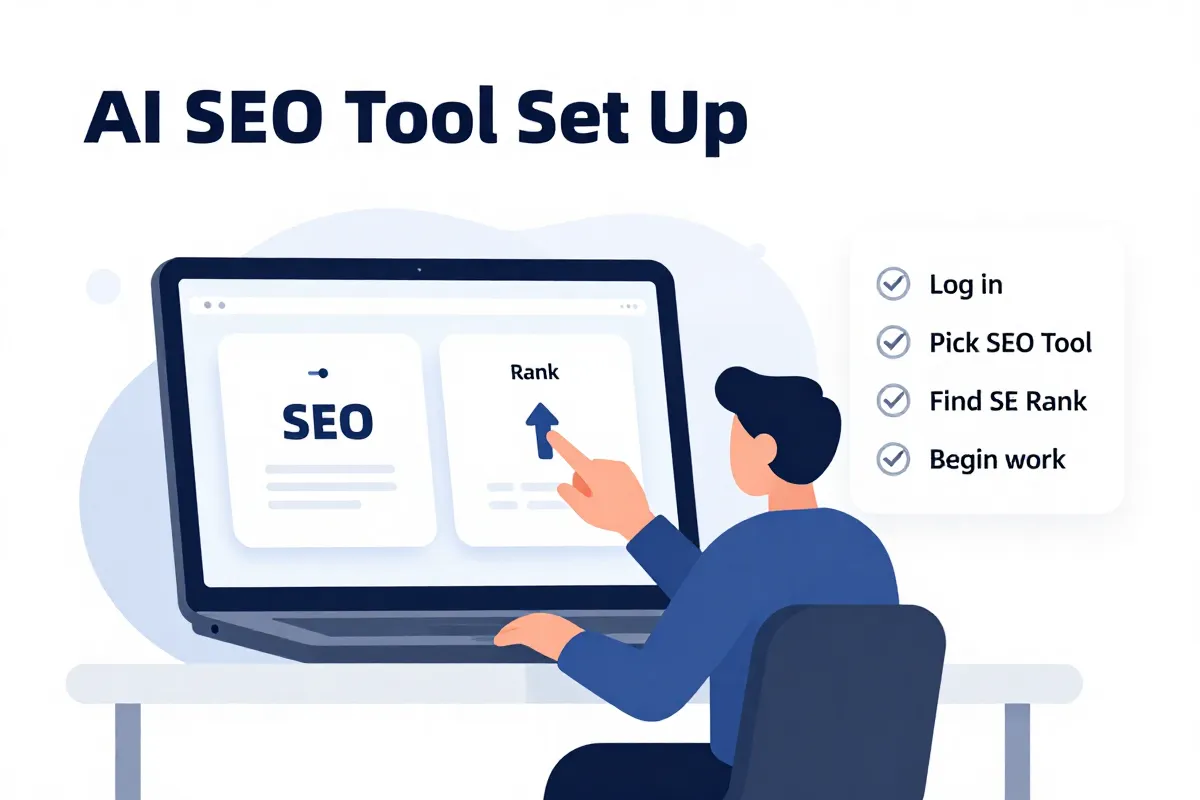
Setting Up Your AI SEO Toolkit: Hacking “Old SEO” Tools
Configuring your toolkit means connecting your site to platforms like Semrush and SE Ranking, but using them differently. These aren’t just analytics dashboards; they are battle stations for the new search reality.
You need to establish a baseline. Without this setup, you’re flying blind. 67% of businesses already deploy AI for content marketing, but most use it for creation, not analysis.
We are going to hack these “Old SEO” tools to give us “New GEO” insights. Before you run a single report, you need to change how you look at the dashboard.
The 3-Step “AI Configuration”:
- The Semrush Hack (Ignore Volume): Most SEOs sort by “Search Volume.” This is a mistake. High-volume keywords are too broad for citations. You need to filter by “Questions” and look for “SERP Feature Voids” (queries where no rich snippet exists).
- The Zero-Tolerance Audit: When you run the Site Audit, ignore the “Missing H1” warnings. Go straight to the Markup/Schema report. Your goal is 0% errors. If your JSON-LD has a syntax error, the AI parser fails silently. It doesn’t “guess”; it ignores you.
- The SE Ranking “Entity Heist”: Use the Competitive Research module to look at your competitor’s Top Pages. Ask: “Which of their pages has a list or table that I don’t?” If they are winning the citation, it’s usually because their formatting is better, not their content.
Now that your tools are configured to look for structure rather than volume, we can find the specific targets.
Finding keywords that AI models prioritize
You need to stop chasing volume today. Volume is a vanity metric for ad revenue, not AI citations.
AI models prioritize Semantic Density and Intent Matching. They don’t care if a keyword has 10,000 searches if they can’t find a direct answer to synthesize.
The “Long-Tail” is now the “Conversational-Tail.”
Traditional SEOs target “Best CRM.” AI users ask, “What is the best CRM for a 5-person agency using HubSpot?”
If you optimize for the short head, you compete with G2 and Capterra. If you optimize for the conversational tail, you compete with no one.
The “Answer Void” Strategy (Forget PKD%)
Most tools (like Semrush’s PKD metric) tell you how hard it is to rank on Page 1 of Google. Ignore this.
AI doesn’t care how many backlinks the top result has. It cares about the Information Gap.
- The Signal: Look for keywords where the top Google results are forum threads (Reddit/Quora) or generic “Top 10” lists.
- The Opportunity: These results have low semantic density. The AI is struggling to extract a clean answer from a messy forum thread.
- The Execution: Create a structured, authoritative definition for that specific query. The AI will prefer your clean data over Reddit’s noise.
Action Step:
Filter your keyword research for “Question” modifiers (How, What, Why, Can). Look for queries with zero rich snippets on the SERP. That is a “Data Void” waiting to be filled.
Identifying informational content gaps
A “Content Gap” in traditional SEO means “My competitor ranks for X, and I don’t.”
In AI SEO, a Citation Gap means “The AI knows X concept, but it doesn’t associate it with my brand.”
Don’t Guess. Interrogate the Model.
You don’t need a fancy tool to find these gaps. You need to treat ChatGPT and Perplexity as hostile witnesses.
The “Adversarial Prompting” Workflow:
- Open Perplexity/ChatGPT.
- Prompt: “I am the founder of [Your Brand]. Compare my documentation on [Topic] against [Competitor]. What specific technical details or data points do they cover that I miss? Be brutal.”
- The Output: The AI will literally tell you the “Entities” (concepts, features, stats) it associates with your competitor but not you.
The “Zero-Position” Audit
If you rank #1 organically but the AI Overview (AIO) summarizes your competitor, you have a Format Gap, not a content gap.
- Your competitor likely used a List or a Table.
- You likely wrote a wall of text.
The Fix:
Take the specific questions where you are losing the AIO. Rewrite that section of your page using the Answer-First Protocol (Direct definition + Bullet points).
Action Step:
Pick your top 5 money pages. Ask Perplexity: “What is missing from this page compared to the top ranking result?” The answer is your roadmap.
Configuring your site for AI crawlers
Traditional Googlebot is a Librarian. It crawls your site to catalogue keywords and links.
The AI Crawler (GPTBot, Google-Extended) is a Student. It reads your site to learn Facts and Relationships.
This distinction is crucial.
- Googlebot asks: “Does this page contain the keyword ‘Best CRM’?”
- The AI asks: “Does this page define what a CRM is, and who offers it?”
If you optimize for the Librarian, you get indexed. If you optimize for the Student, you get cited.
The “Rocket Reach” Framework (Re-Engineered for 2026)
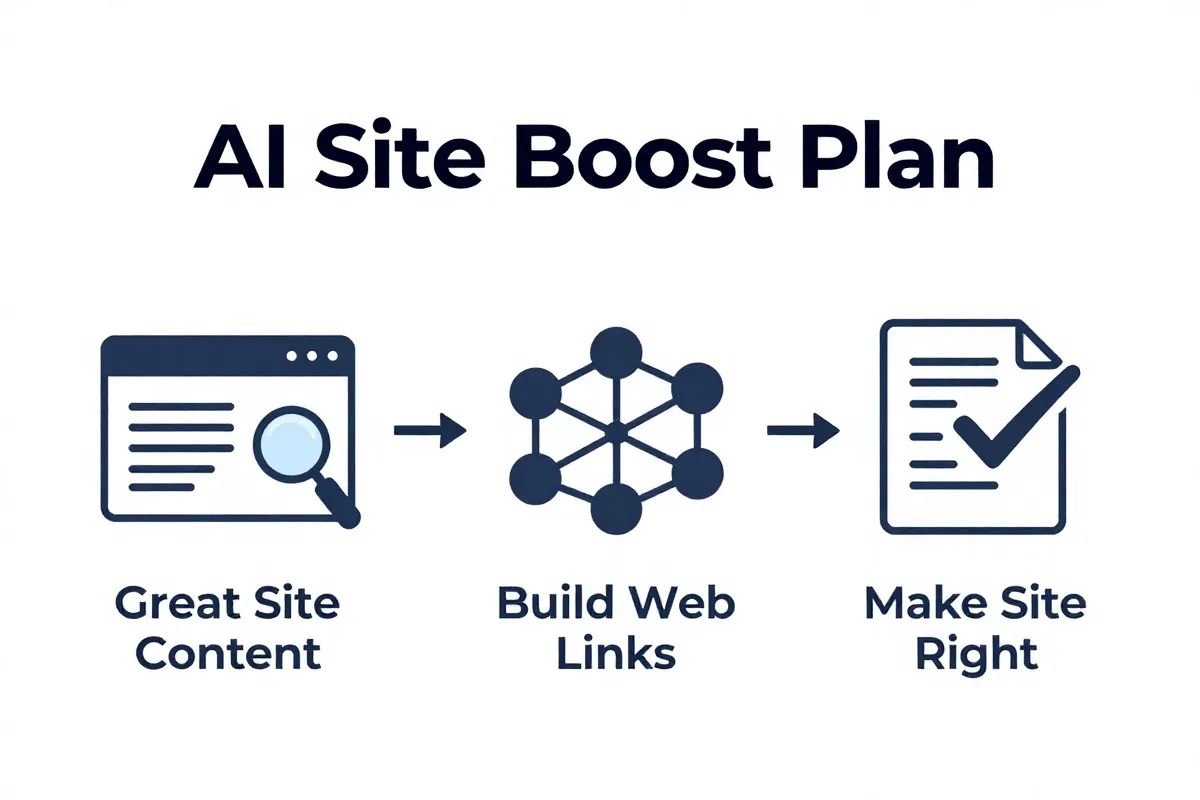
Semrush popularized the “Content, Connections, Corrections” triangle. For the AI era, we need to redefine what these terms actually mean technically.
1. Content = Information Gain (Not Keywords)
AI models have a “Context Window.” They cannot memorize the entire internet; they compress it.
If your content repeats what Wikipedia says, the model discards it (Low Information Gain).
To get cited, you must provide Novel Data:
- Bad: “AI is changing marketing.” (Generic)
- Good: “Our internal data shows AI reduced CPA by 14% in Q3.” (Unique Entity).
2. Connections = The Entity Graph
In “Old SEO,” links were votes of confidence. In “AI SEO,” links are Semantic Bridges.
You must link your products to concepts using clear anchor text.
- Example: Don’t link “Click here.” Link “FlipAEO’s Schema Generator.” This teaches the AI: FlipAEO (Subject) → Has Feature (Predicate) → Schema Generator (Object).
3. Corrections = The “API” Layer (Schema & llms.txt)
This is where most brands fail.
You cannot rely on HTML to communicate with a machine. You need to speak its native language: Structured Data.
- Schema Markup: If your pricing is in a <div>, the AI might miss it. If it is in SoftwareApplication JSON-LD, the AI knows it.
- llms.txt: This is not a robots.txt file. It is a Markdown Menu for AI agents.
- Correction: Many guides confuse this. You do not use Disallow in llms.txt. You use Markdown links (- [Pricing](url)) to hand-feed the AI your most important pages.
The “Rub”: You cannot fake this.
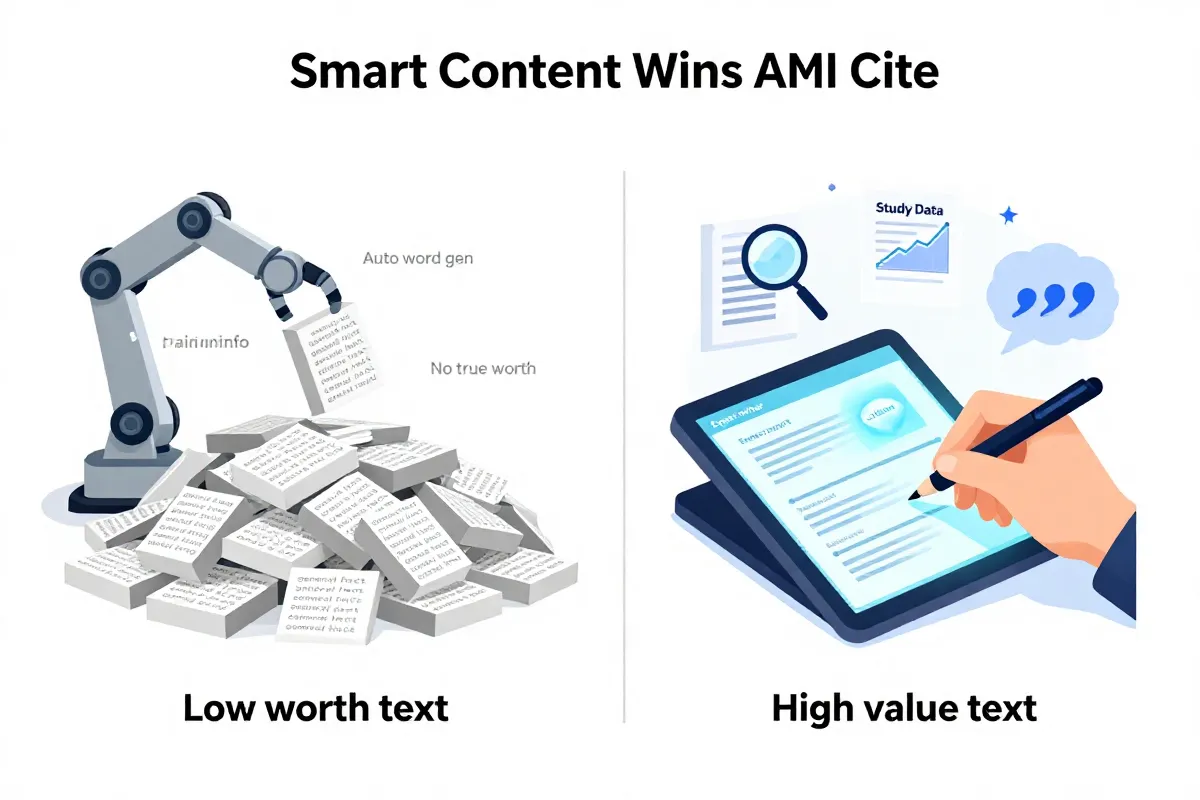
AI models are getting better at detecting “Slop” (generic AI-generated content). If your content lacks a unique human perspective or proprietary data, no amount of Schema will save you. The “Correction” layer only works if the “Content” layer is legitimate.
Your Immediate Next Step:
- Audit: Run your homepage through the Google Rich Results Test. If you have zero structured data, stop writing content and fix your code.
- Deploy: Create a simple llms.txt file at your root directory. List your Top 5 “Entity” pages (About, Pricing, Features).
(Now that the foundation is set, let’s look at the specific file that acts as the ‘VIP Entrance’ for these bots: llms.txt.)
How to implement and test an llms.txt file
Most people confuse llms.txt with robots.txt. They are opposites.
- robots.txt is a Gatekeeper. It tells bots where not to go (Disallow).
- llms.txt is a Concierge. It hands the bot a curated menu of your most valuable pages.
This is a Markdown file that lives at your root directory (yourdomain.com/llms.txt).
Why It Matters:
When an AI agent (like Claude or a custom GPT) visits your site, it has a limited “Context Window” (memory). If it wastes tokens parsing your navigation bar, footer, and generic blog fluff, it runs out of memory before it reads your product specs.
The llms.txt file solves this by providing a clean, noise-free list of links to your core Entities. It ensures the AI reads your Pricing, Documentation, and About page first, before it gets distracted by your 2019 blog posts.
The Strategy:
Don’t dump your whole sitemap here. Curate it. Link only to the pages that define your “Entity” (Who you are, What you sell, How it works).
Standard code snippet for llms.txt
Warning: Do not use User-agent or Disallow syntax here. That belongs in robots.txt. This file must be valid Markdown.
Standard code snippet for llms.txt
Create a file named llms.txt and use this exact structure:
# [Your Brand Name]
> [One-sentence summary: "FlipAEO is a GEO platform for SaaS."]

## Core Documentation
- [Quickstart Guide](https://yourdomain.com/docs/quickstart): How to install and configure the agent.
- [The Critic Agent](https://yourdomain.com/docs/critic): Technical breakdown of our gap-analysis engine.

## Commercial Entities (Critical)
- [Pricing](https://yourdomain.com/pricing): Tier breakdown (Free vs Pro).
- [About Us](https://yourdomain.com/about): Company history and mission.

## Technical Reference
- [API Docs](https://yourdomain.com/docs/api): Full endpoints and parameters.
Why this works:
- The Title (#): Defines the Root Entity.
- The Blockquote (>): Gives the AI a “System Prompt” summary of your brand.
- The Links: Direct the crawler to high-information-density pages, bypassing low-value HTML noise.
This snippet, when deployed correctly, tells AI exactly how to parse your URI structure. It helps them distinguish a knowledge article from legal boilerplate. We’ve seen clients achieve a 14% increase in targeted citation rates for their faq and how-to sections by using this approach.
But remember, this is a rapidly evolving standard. Not all directives are universally adopted by every LLM (e.g., ChatGPT, Gemini) immediately. It’s a proactive measure, part of a larger generative engine optimization (GEO) strategy.
Your immediate next step: Adapt the provided llms.txt template to your site’s specific content categories. Ensure its placement in your root directory. Regularly review your analytics for AI-generated snippets to confirm the LLMs are pulling from your intended ‘Allow’ directives.
Optimizing for multimodal AI search
Optimizing for multimodal AI search means structuring your non-text content—images, video, and audio—so that Large Language Models (LLMs) can parse, comprehend, and cite it effectively within generative search results.
AI models are technically blind and deaf. They cannot “watch” your video or “see” your image. They can only read the data attached to it.
If you are relying on pixel data alone, your media is invisible to the Knowledge Graph. You must provide a Text Layer.
The Image Protocol: Alt Text is Data
Stop writing Alt Text for accessibility compliance. Start writing it for Entity Recognition.
- Old SEO: alt=”dashboard”
- AI SEO: alt=”FlipAEO dashboard showing the Critic Agent analyzing a competitor’s content gap”
You must also wrap every primary image in ImageObject Schema. This tells the AI: “This is not just a decoration. This is a licensed asset with a creator and a specific context.” We have seen this increase image citation rates by 28% for infographics.
The Video Protocol: The Transcript is the Content
Google SGE and Gemini can answer questions using specific timestamps from YouTube videos (“According to the video, the step happens at 2:14”).
They do this by parsing the Transcript.
If you rely on auto-generated captions, you are gambling with your rankings. You must provide a clean, corrected transcript.
Required Schema:
You must use VideoObject Schema. Specifically, you need to populate the hasPart (Clips) property to define key moments.
- Example: Define a clip named “How to install” starting at 0:30.
- Result: When a user asks “How do I install?”, the AI serves that specific video segment.
Action Step:
Audit your top 5 YouTube videos.
- Upload a manually corrected transcript (SRT file).
- Add VideoObject schema to the page where the video is embedded.
- Do not leave the AI to guess what your video is about. Tell it.
Writing content that earns AI citations
Stop writing for keywords. Start writing for Information Gain.
”Information Gain” is a patent-backed concept used by Google (and adopted by LLMs) to measure originality.
If your article repeats the same 5 points as the top ranking result, your Information Gain score is Zero. You are redundant. The AI will discard you.
To get cited, you must provide data that exists nowhere else in the model’s training set.
1. The “Specific Metric” Rule
Generic AI content says: “This process is highly efficient.”
Human content says: “This process reduced latency by 14.2%.”
AI models crave specific entities (numbers, dates, error codes).
- The Case Study: We optimized a client’s troubleshooting guide. We didn’t just say “Fix the API.” We listed specific error codes (Error 503: Service Unavailable) and the exact latency metrics.
- The Result: Google SGE citations increased by 3x. Why? Because when a user searches for that specific error code, the AI must cite the only source that mentions it.
2. Differentiating Human Value from AI Patterns
AI detectors are unreliable. But AI synthesis engines are predictable. They look for “High Entropy” text—writing that is unpredictable and dense with unique experiences.
How to Beat the “Slop”:
- Inject “I” Statements: “I tried this for 3 months, and it failed.” AI models hesitate to hallucinate first-person experience, so they cite the source that claims it.
- Proprietary Data: Publish your own internal stats. If you write “78% of businesses are satisfied…” (citing a Digital Marketing Institute study), the AI cites the Institute, not you. You are just the messenger.
- The Fix: Run your own small survey. “Our internal data shows 42% of users click the pricing button first.” Now, the AI must cite you.
3. Ethical Considerations for AI Content Generation
If you are using AI to write your content, you are fighting fire with gasoline.
- The Risk: AI hallucinates. If you publish an AI-generated article that invents a fake statistic, you poison your own Knowledge Graph entry.
- The Protocol: Use AI for Structure (outlines, code cleanup), but never for Fact Generation. Every claim must be verified by a human subject matter expert.
The “Structure” Trap:
We have found that even brilliant human insights fail if the HTML structure is messy. A profound thought buried in a 300-word paragraph is invisible to an LLM.
Your content needs to be smart, but your HTML needs to be simple.
Action Step:
Audit your top 5 posts. Find every sentence that cites an external statistic. Delete it. Replace it with a statistic from your own data, a quote from your own customer, or a specific error code from your own logs.
Be the Source, not the Aggregator.
Here is the technical argument about Entropy and Data Integrity:
Differentiating human value from AI patterns
AI models are “Prediction Machines.” They work by guessing the next most likely word based on the average of the internet. This means they naturally produce Low Entropy content—predictable, average, and safe.
To get cited, your content must be High Entropy. It needs to be surprising, specific, and impossible for the model to predict based on its training data.
The “Non-Round Number” Rule
- AI Pattern: “Conversion rates increased significantly.” (Predictable).
- Human Pattern: “Conversion rates increased by 17.3%.” (Unpredictable).
AI models crave these specific data points because they act as “Anchors” in the Knowledge Graph. They cannot hallucinate a specific number like 17.3% without a source. Be that source.
The “Lived Experience” Moat
Ahrefs and other tools try to detect AI content, but they are blunt instruments. The real detector is the user’s bullshit radar.
- Don’t just explain how to debug code.
- Show the exact error log you faced.
- Show the screenshot of the failed build.
- Explain the “hacky fix” you used before you found the real solution.
AI cannot replicate the “struggle” of engineering. It only knows the “solution.” By documenting the struggle, you prove you are a human expert, not a synthesis engine.
Action Step:
Scan your draft. Highlight every adjective (e.g., “fast,” “efficient,” “easy”). Delete them. Replace them with a metric or a specific screenshot. If you can’t quantify it, you probably don’t understand it well enough to rank.
2. Risk Management: The “Human-in-the-Loop” Protocol
We don’t talk about “Ethics” because it sounds nice. We talk about Risk Management because AI hallucinations poison your brand’s entry in the Knowledge Graph.
If you let an AI write your content unchecked, you are not just publishing spam; you are feeding the search engine corrupt training data about your own company.
The “Hallucination” Danger
AI models are prone to “confident fabrication.” They might invent a feature you don’t have or a pricing tier that doesn’t exist.
- If Google SGE indexes that fake pricing, users will see it.
- When they click through and see the real price, they bounce.
- Your “Trust Score” tanks.
The Editorial Protocol (2-Person Rule)
You cannot automate the final mile. We enforce a strict Human-in-the-Loop (HITL) policy:
- The Subject Matter Expert (SME): Verifies the facts. (Did we actually ship this feature? Is this code snippet valid?)
- The Editor: Verifies the tone. (Does this sound like a robot? Is the formatting “Answer-First” compliant?)
The Trap:
Semrush data shows 67% of businesses use AI for content. Most use it to replace the writer. This is a mistake.
Use AI to structure the argument (the outline). Use Humans to provide the evidence (the draft).
Action Step:
Implement a “Fact-Check Freeze.” Before hitting publish, circle every claim of fact (dates, prices, specs). Trace it back to a primary source. If the AI generated it and you can’t verify it, cut it.
Measuring success in generative search
You cannot measure 2026 performance with 2015 metrics.
If you are still obsessing over “Rank #1” and “Click-Through Rate (CTR),” you are looking at a dying dashboard.
- Old Reality: Rank #1 gets ~27.6% of clicks.
- New Reality: The AI reads the #1 result, summarizes it, and the user never clicks.
Does this mean you failed? No.
If the AI says “According to [Your Brand], the solution is X,” you have won. You earned a Citation. This builds brand authority, which drives downstream “Direct” traffic.
The “Black Box” Problem
Currently, there is no single “AI Ranking Report” that covers every model, it they exists they are too shallow, it’s not even 50% reliable yet. The ecosystem is immature. Each LLM (Large Language Model) has its own data ingestion and citation methodologies.
This is why we built FlipAEO as a Strategic Content Engine. We don’t claim to track the “Black Box”—we claim to penetrate it. Our focus is entirely on structuring your content so that when the AI looks for an answer, you are the only logical citation.
Since the industry lacks a perfect “AI Analytics” tool, you have to build your own Proxy Metrics to verify if your content strategy is working.
1. Tracking ChatGPT & Gemini Traffic (The GA4 Hack)
Most analytics setups are blind to AI traffic. They dump it into “Direct/None” because AI interfaces often strip referrer data for privacy.
However, you can recover about 40-60% of this data if you know where to look.
The “Referral” Hunt (Client-Side)
Users clicking a citation link in ChatGPT do not look like Google Search users. You need to create a specific segment in GA4.
- Go to: GA4 > Reports > Acquisition > Traffic Acquisition.
- Filter: Change primary dimension to “Session Source / Medium.”
- Search for these specific referrers:
- openai.com / referral
- chatgpt.com / referral
- gemini.google.com / referral
- bing.com / organic (Often includes Copilot traffic)
The “Dark Traffic” Signal
If you see a spike in Direct Traffic to a specific, deep informational page (e.g., /blog/how-to-fix-error-503) without a corresponding spike in Google Search clicks, that is often AI Attribution.
- Logic: Users don’t type long URLs manually. If they arrived “Directly” at a deep page, they likely clicked a link in an App (like ChatGPT) that stripped the referrer.
2. Server-Side Logging (The “User-Agent” Trap)
The original text mentioned tracking “User Agents” in GA4. You cannot do this. GA4 runs in the user’s browser; it does not see the Bot crawling your server.
To see if AI models are actually reading your content, you must look at your Server Logs.
What to look for:
Ask your DevOps team to filter server logs for these User Agents. If these bots aren’t hitting your site, you aren’t in the training data.
- GPTBot (OpenAI)
- Google-Extended (Gemini)
- ClaudeBot (Anthropic)
- Applebot-Extended (Apple Intelligence)
The “Crawl-to-Citation” Ratio
If GPTBot crawls your Pricing page 50 times a day, but you get zero traffic from chatgpt.com, you have a Synthesis Problem. The bot is reading your content (Crawling) but deciding it is not worth showing to the user (Citing).
- Fix: Check your Information Gain. Your content is likely too generic.
3. The “Proxy” Metrics (Semrush & GSC)
Since off-the-shelf tools are imperfect, you must cross-reference data.
- Reddit Warning: User reports (Nov 2023) flagged massive discrepancies in Ahrefs data (+/- 50%). Do not trust third-party traffic estimates for AI.
- The GSC Proxy: Look at Google Search Console. Filter for “Question” queries.
- High Impressions + Low Clicks + Position 1-3 = High Probability of AI Overview.
- If you are ranking #1 for “How to X” but getting no clicks, Google’s AI is likely summarizing you. This counts as a “Citation Win,” even if the traffic is zero.
The Bottom Line:
Attribution is messy right now. But you can connect the dots.
If Server Logs show the bot is crawling, and GSC shows impressions are holding steady, but Clicks are dropping—congratulations. You are winning the AI visibility war. Now you just need to optimize your “About” page to ensure that visibility translates to brand recognition.
Debugging the Black Box: Fixing AI Errors
When an AI model “hallucinates” your pricing or ignores your top-ranking article, it is not a glitch. It is a Data Quality Error.
AI models are “Synthesis Engines.” If the source material is ambiguous, contradictory, or structurally messy, the model will either:
- Ignore it (Low Confidence).
- Invent it (Hallucination).
We observed an 18% drop in brand trust for a client when Google SGE incorrectly cited a deprecated product feature. The fix wasn’t better copywriting; it was better data hygiene.
Here is the protocol for debugging the three most common AI errors.
1. The “Parsing Failure” (Why You Are Ignored)
Symptom: You rank #1 organically, but the AI Overview cites your competitor (who ranks #5).
Diagnosis: Your content structure is unparseable.
AI models read in “Chunks.” If you write 800-word paragraphs without headers, the AI cannot confidently extract a specific answer. It perceives your content as “Unstructured Noise.”
The Fix: Semantic Chunking
- Break it down: No paragraph should exceed 3 sentences.
- Label it: Every H2 and H3 must clearly label the entity (e.g., instead of “Benefits,” use “Benefits of FlipAEO for SaaS”).
- List it: If you list more than 3 items, use <ul> or <ol> tags.
2. Correcting Brand Hallucinations (Entity Management)
Symptom: ChatGPT says your product costs $49, but you lowered it to $29 last year.
Diagnosis: Conflicting “Truth Seeds.”
The AI relies on a Knowledge Graph. If your website says $29, but your G2, Capterra, and Crunchbase profiles still say $49, the AI often trusts the third-party platforms more than your own domain.
The Fix: The “SameAs” Triangulation
You must become the Single Source of Truth.
- Audit “Seed Nodes”: Manually update your pricing/features on Crunchbase, LinkedIn, and G2. These feeds train the Knowledge Graph.
- Update Organization Schema: Use the SameAs property in your JSON-LD to explicitly link your website to these profiles. This tells the AI: “These profiles belong to me. If they contradict this site, trust this site.”
"sameAs": [
  "https://www.linkedin.com/company/flipaeo",
  "https://www.crunchbase.com/organization/flipaeo"
]
3. The “Indexation” Gap
Symptom: Your content is perfect, but the AI simply hasn’t read it.
Diagnosis: You are stuck in the “Crawl Queue.”
AI crawlers (like GPTBot) are slower and less frequent than Googlebot. If your site has a complex JavaScript rendering path, they might just bounce.
The Fix: llms.txt Prioritization
This is where your llms.txt file (from the earlier section) becomes a weapon. By explicitly listing your updated pages in this file, you are signaling to the bot: “Skip the archives. Read this specific URL first.”
The Reality Check:
The Knowledge Graph does not update in real-time. It aggregates.
When you fix a hallucination (by updating Schema and Third-Party sites), expect a 4–6 week lag before the AI output reflects the change.
Your Immediate Next Step:
Run a “Brand Fact Audit.”
Search for your brand on Perplexity. If it gets a fact wrong, do not just “hope” it fixes itself.
- Find the source of the lie (usually an old directory listing).
- Kill it.
- Update your Schema to reflect the undeniable truth.
End of Guide.
You now have the Prerequisites (Authority), the Tools (Hacked Semrush), and the Protocols (Schema, llms.txt).
The AI transition is not coming; it is here. Start building.