
⚡ Executive Summary (TL;DR)
The Core Thesis:Global search interest for “SEO” has hit a 20-year peak in 2026. This is not a sign of industry growth; it is a sign of market panic.
As AI Search engines (ChatGPT, Perplexity, Gemini) steal market share and Google’s “AI Overviews” dominate the SERP, traditional traffic sources are drying up. Businesses are frantically searching for “SEO” to fix their broken funnels.
The Hard Truth: Traditional “Blue Link” SEO tactics (keyword stuffing, backlink buying, skyscraper content) are dead or dying. The only way to survive the 2026 shift is to pivot to AEO (Answer Engine Optimization), optimizing your content to be cited as the “Source of Truth” by Large Language Models.
The Panic Curve: Interpreting the 2026 SEO Spike
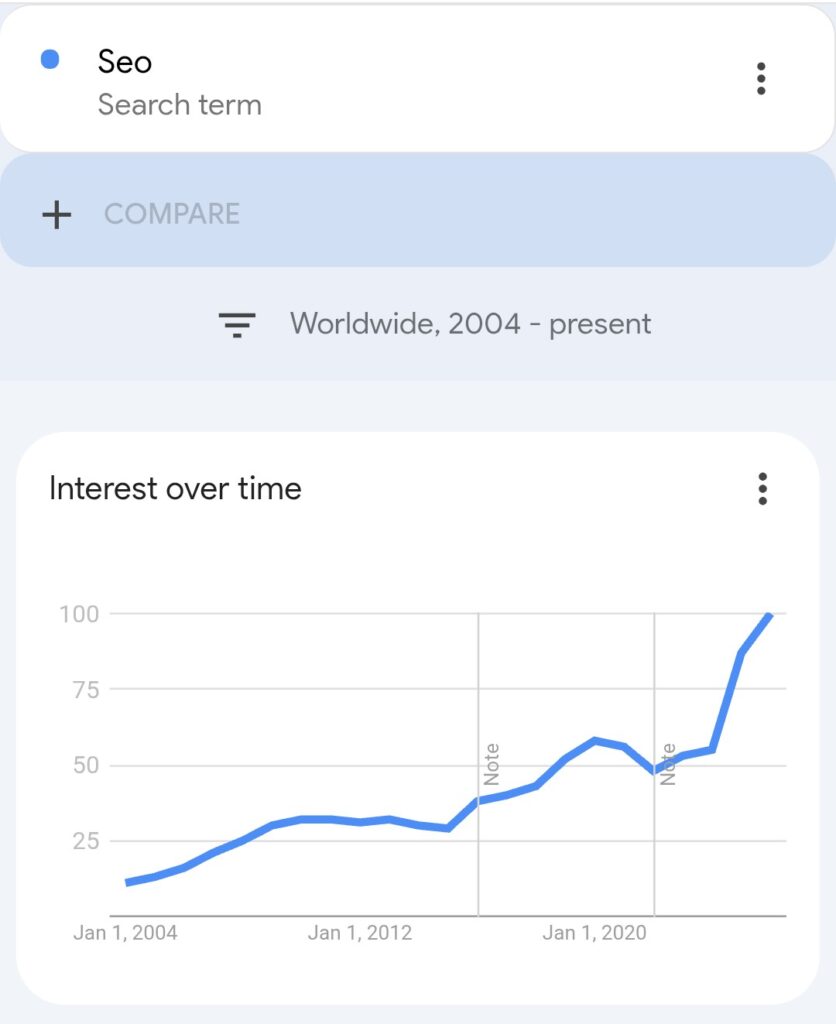
If you look at Google Trends this week, you will see a startling anomaly. After years of steady, flat interest, the search volume for “SEO” (Search Engine Optimization) has gone vertical. It has surpassed its previous all-time high.
To the uninitiated, this looks like a boom. To the veteran, this looks like a correction event.
Why are millions of business owners suddenly obsessed with SEO in February 2026? It is because the “Set it and forget it” era is over. The tactics that worked in 2023 – programmatic spam, generic AI writing, and guest post link building have simultaneously collapsed under the weight of two massive forces:
- The Google Quality Purge: Google’s continuous core updates have finally de-indexed the “heavily optimized but useless” content farms.
- The AI Zero-Click Reality: Users are no longer clicking ten blue links to find an answer. They are asking Perplexity or ChatGPT and getting the answer directly.
The spike in the graph isn’t people looking for growth. It’s people looking for repair. They are asking, “Where did my traffic go?”
If you are reading this because your traffic graph looks like a ski slope, the bad news is that “more SEO” won’t fix it. The good news is that there is a new game in town, and the board is wide open.
The Death of the “10 Blue Links” Paradigm
For 25 years, the internet worked on a simple contract:
- You create content.
- Google indexes it.
- Users search keywords.
- Users click your link to read the answer.
In 2026, that contract of ’10 Blue links’ is broken.
The Rise of Retrieval-Augmented Generation (RAG)
Modern search engines (both Google’s Gemini-powered search and standalone AI like ChatGPT) no longer just “retrieve” links. They “generate” answers.
They use a process called RAG (Retrieval-Augmented Generation).
- The Prompt: A user asks, “What is the best CRM for small agencies?”
- The Retrieval: The AI scans its index (and the live web) to find facts.
- The Synthesis: The AI writes a brand new, unique answer for that user.
- The Citation: The AI might link to 1 or 2 sources it trusted the most.
Here is the terrifying part for traditional SEOs: The AI does not care about your Domain Authority (DA). It does not care about how many backlinks you bought. It does not care if you used the keyword “Best CRM” 15 times in the H2s.
It only cares about Information Gain and Structural Trust. If your content is buried in fluff, the AI skips it. If your content is structured data, the AI cites it.
SEO vs. AEO: The 2026 Comparison Matrix
| Feature | 📉 Traditional SEO (The Old Way) | 📈 FlipAEO / AEO (The New Way) |
| Primary Goal | Rank #1 in Google Blue Links. | Be the #1 Cited Source in ChatGPT/Perplexity. |
| Target Audience | Humans searching strictly on Google. | Humans and LLM Training Data. |
| Content Strategy | “Skyscraper” Content: Long, fluffy guides (3,000+ words) covering everything to maximize “Time on Page.” | “Atomic” Content: Concise, data-dense entities structured with direct answers and tables. |
| Success Metric | Organic Traffic / Click-Through Rate (CTR). | Brand Mentions / AI Citations / Referral Traffic. |
| Optimization Tech | NLP Keywords: Stuffing synonyms (LSI) to match a query. | Semantic Entities: Defining concepts clearly so machines understand the relationship between topics. |
| Indexing Speed | Slow (Weeks/Months). | Instant (Real-time RAG retrieval). |
Why Traditional SEO Tools (Surfer, Byword, Jasper) Are Failing
The panic in the market is being fueled by tools that are selling outdated maps for a new territory.
The “Blue Link” Obsession
Tools like Surfer SEO were built to reverse-engineer the Google SERP of 2021. They analyze the top 10 ranking pages and tell you: “The top pages have 2,000 words, so you should write 2,100 words.”
In an AI world, this is suicide. AI users want the answer, not a novel. If you bloat your content to satisfy a “Content Score,” you are actually making your content harder for an LLM to parse.
The “Programmatic Spam” Trap
Tools like Byword or Koala allow you to generate 1,000 articles in a click. In 2023, this worked. In 2026, Google’s “SpamBrain” and LLM filters are aggressively de-indexing this content.
Why? Lack of Information Gain.
If 1,000 pages are all AI-summaries of the same Wikipedia article, they add zero value to the web. AI search engines are trained to ignore redundant data. To rank now, you need Net-New Data—something FlipAEO’s engine is specifically designed to uncover through “Semantic Gap Analysis.”
The Solution: The “Triangle of Visibility”
If you want to survive the 2026 shift, you must stop thinking about “Pages” and start thinking about “Data.” At FlipAEO, we have identified the three signals that Answer Engines look for. We call this the Triangle of Visibility.
1. Indexability (The Technical Foundation)
You cannot be cited if you aren’t found. While AI is the future, Google is the gatekeeper.
Most AI search engines (like Perplexity) still use Google’s index as a primary data source. If your site has technical bloat, slow load times, or “crawled – currently not indexed” errors, you are invisible to the AI.
2. Topical Purity (The Authority Signal)
You cannot be an expert on everything.
In the old days, a “lifestyle blog” could rank for credit cards, recipes, and travel. Today, LLMs rely on Vector Embeddings. They map your site’s topic. If you write about “Cat Food” today and “Crypto” tomorrow, the AI marks you as “Low Confidence.”
- The FlipAEO Fix: We don’t write random articles. We build Entity Clusters—30 interlinked articles that cover one specific topic in extreme depth (e.g., “SaaS Churn Recovery”). This forces the AI to recognize you as the Subject Matter Expert.
3. Structural Trust (The “Citation” Hook)
This is the most important factor for 2026.
LLMs are lazy. They prefer data that is easy to read. They hate wall-of-text paragraphs. They love:
- Markdown Tables (for comparisons).
- Bullet Lists (for steps).
- Bolded Definitions (for direct answers).
If you format your content with Structural Trust, you are effectively “spoon-feeding” the AI. It wants to cite you because you made its job easy.
Case Study: Proof That AEO Works (When SEO Fails)
We didn’t just build FlipAEO; we tested it.
While the industry was panicking about traffic drops, we launched a test domain, Bringback.pro, using the FlipAEO engine.
The Strategy:
- Zero traditional link building.
- Zero human-written “fluff” posts.
- 100% FlipAEO-generated “Entity Clusters” targeting high-intent SaaS recovery terms.
The Result (90 Days Later):
- Google Search Console: 120,000 Impressions / 1,800+ Clicks.
- AI Search: 500+ Direct Citations from ChatGPT and Perplexity.
- Ranking: Top 3 positions for keywords that major competitors (using traditional SEO) were fighting for.
How to Pivot Your Strategy Today (The AEO Checklist)
If you are part of the surge in “SEO” interest, stop buying backlinks and start optimizing for answers. Here is your immediate action plan:
Step 1: Audit for “Fluff”
Look at your top 10 pages. Do they start with “In today’s digital landscape…”?
Delete it.
Start every page with a Direct Answer.
- Bad: “There are many factors to consider when choosing a CRM…”
- Good (AEO): “The best CRM for small agencies in 2026 is HubSpot due to its free tier and native AI integration.“
Step 2: Implement “Extraction Tables”
Go to your comparison posts (“X vs Y”). Are they just text?
Convert them into HTML Data Tables.
- Row 1: Feature.
- Row 2: Competitor A.
- Row 3: Your Brand.
AI engines scrape these tables to generate their own comparison answers. If your data is in the table, your brand gets the citation.
Step 3: Switch from Keywords to Questions
Don’t target “Best running shoes.”
Target the conversational long-tail: “What are the best running shoes for flat feet under $100?”
FlipAEO’s engine automatically identifies these “Shadow Questions”—the specific, complex queries that humans ask chatbots but often fail to type into Google.
Conclusion: The “Hybrid Moat”
The spike in SEO interest is real. The fear is real. But the solution isn’t to double down on the past.
The winners of 2026 won’t be the ones with the most backlinks. They will be the ones who build a Hybrid Moat:
- Google-Ready: Technically sound, indexed, and fast.
- AI-Native: Structured, data-dense, and formatted for RAG extraction.
Traditional SEO won’t save you. Answer Engine Optimization (AEO) will.
You can spend the next 6 months trying to manual-write your way out of this hole, or you can use the engine built for this exact moment.
Start Building Your AEO Strategy with FlipAEO Today
🙋 Frequently Asked Questions (FAQ Schema)
Why is SEO interest spiking in 2026?
SEO interest is spiking because traditional organic traffic is crashing for many businesses due to Google AI Overviews and the rise of chatbots like ChatGPT. Business owners are panic-searching for SEO solutions to recover lost visibility, not realizing they need to pivot to Answer Engine Optimization (AEO) to be cited in generated answers.
Is SEO dead in 2026?
Traditional “Blue Link” SEO—optimizing purely for 10 organic links—is dying. However, Search itself is growing. It has evolved into a Hybrid Model where users search on both Google (for links) and AI (for answers). Brands that ignore AEO (optimizing for AI citations) will see their traffic disappear, while those building a “Hybrid Moat” will thrive.
What is the difference between SEO and AEO?
SEO (Search Engine Optimization) focuses on ranking a webpage on Google’s first page to get a click. AEO (Answer Engine Optimization) focuses on structuring content (using data tables and direct definitions) so that AI models like ChatGPT and Perplexity understand it and cite it as the “Source of Truth” in their generated answers.
How do I get my website cited by ChatGPT and Perplexity?
To get cited, you must move beyond keyword stuffing. You need to provide Net-New Information (unique data/stats), use Structural Trust (formatting content with Markdown tables and bolded lists), and build Topical Authority (covering a niche with a cluster of 20-30 interlinked pages). FlipAEO automates this exact process.
Why are traditional SEO tools like Surfer or Byword failing now?
Legacy tools optimize for the “Old Google.” Surfer focuses on word count and keyword density (which LLMs often ignore as fluff), while Byword focuses on mass programmatic volume (which Google’s SpamBrain now penalizes). In the AI Era, quality, structure, and entity depth matter more than volume or keyword matching.