
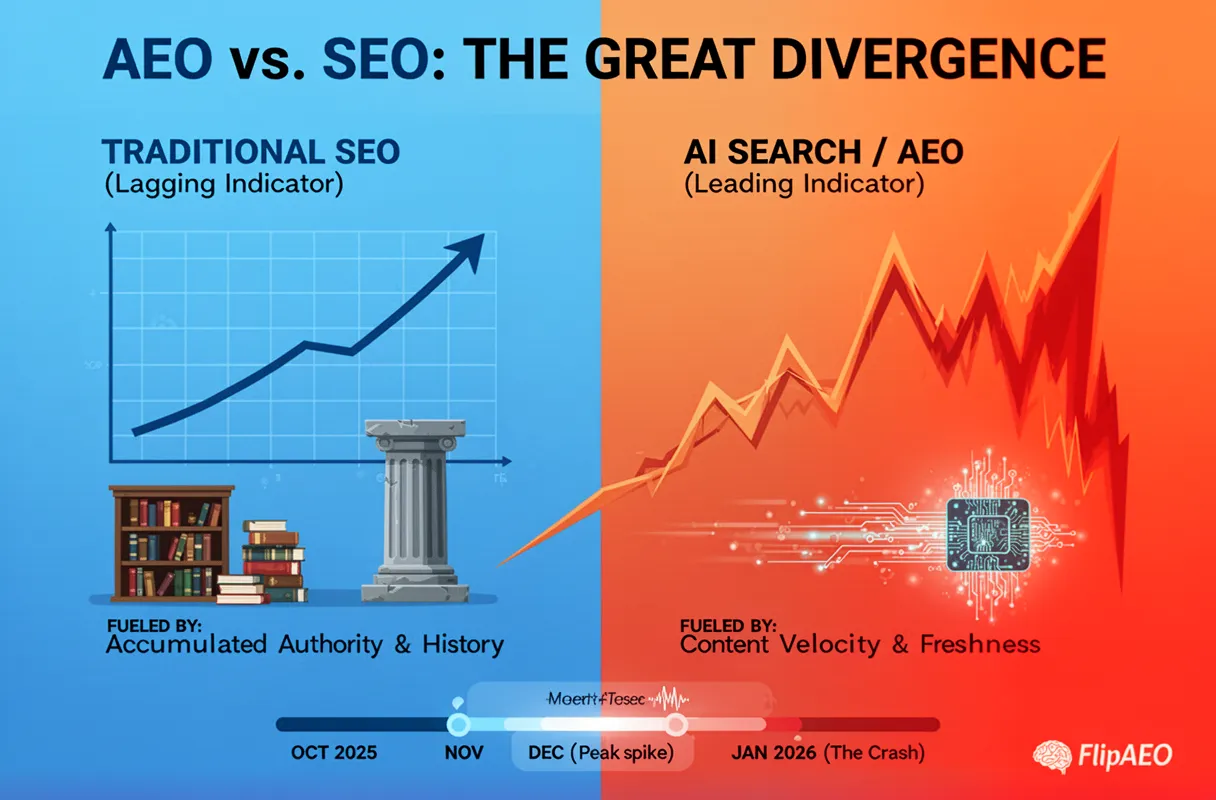
In January 2026, we watched a brand’s traffic split in two opposing directions.
In a four-month sprint, the brand stopped publishing new content in 4th month. The result should have been a uniform plateau. Instead, Google traffic jumped 56%, while AI referrals crashed 26%.
This divergence settles a debate that has divided marketers for the last year: Does good SEO automatically equal good AI visibility?
The answer is a definitive yes and no. You don’t required to rank on google to be citable by AI Search. But your strong seo foundation is the way to go.
At FlipAEO, we tracked a seasonal brand through a “perfect storm” of variables – a fresh domain launch, high-velocity publishing, and a sudden full-stop in production. The resulting dataset proves that LLMs and traditional search engines are no longer just different platforms, they are operating on fundamentally different incentives.
The 3 Key Findings:
- Zero-Rank Visibility: The site generated significant traffic from ChatGPT to pages that had near-zero visibility on Google.
- The Freshness Decoupling: When the “publishing heartbeat” stops, AI visibility decays (-49%), while SEO traffic continues to coast on historical authority.
- Velocity vs. Authority: AEO algorithms appear to weight “Content Velocity” (Content freshness) far higher than domain age or backlink profile.
1. How We Structured the Test
To truly isolate the difference between “Ranking Authority” and “Content Velocity,” we needed a clean environment. We tracked a seasonal niche brand launched on a fresh domain in October 2025 using Google Analytics 4 (GA4).
The Control Variable – FlipAEO
We utilized the FlipAEO Strategic Content Engine to handle the entire research and publishing workload. This removed human inconsistency from the equation, ensuring a mathematically precise publishing cadence (scaling from 1 post/week to 1 post/month) to test algorithm reaction times.
The Signals We Tracked
We specifically isolated google / organic against the combined volume of chatgpt.com / referral and the elusive (not set) parameter:
- The Old Guard (SEO): google / organic
- Represents: Traditional keyword ranking and domain authority.
- The New Wave (AEO): chatgpt.com / referral + (not set)
- Represents: Large Language Model citations and conversational search.
Note on the “Not Set” Metric: Many marketers ignore this, but we found it crucial. In the context of ChatGPT, (not set) usually indicates traffic from SearchGPT or deep-research modes where referral strings are scrubbed. This isn’t junk traffic; it is often the highest-intent traffic available.
Disclaimer: This case study represents a data snapshot based on a single domain operating within a high-velocity seasonal niche (Holiday/Gift) during Q4 2025. We present this data not as a finalized “Law of Search,” but as a strong directional signal. We encourage marketers to use this as a framework for their own testing rather than an absolute universal baseline for AEO.
2. The Timeline Analysis
Data is static, but traffic is a story. Over the course of 120 days, we observed four distinct “behavioral phases” in how algorithms treated the brand.
At first glance, Google and AI traffic appeared to move in lockstep. However, by breaking the timeline down month-by-month, we exposed the moment the two algorithms “decoupled.”
What follows is the month-by-month anatomy of that split.
Phase 1: The Indexing Baseline
Period: October 2025
Status: Site just indexed. Minimal content history.
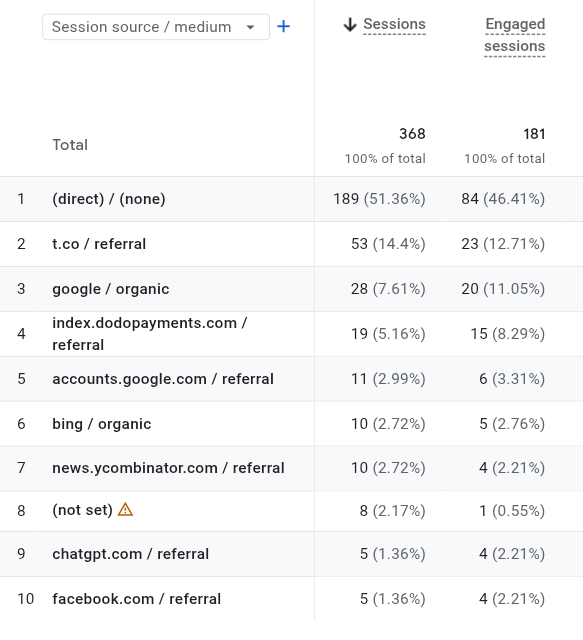
| Metric | Sessions | Status |
|---|---|---|
| Google Organic | 28 | Sandbox Mode. Virtually non-existent visibility. |
| ChatGPT Referrals | 5 | Active. Immediate citations detected. |
The Anomaly
How did LLMs find the brand if Google didn’t rank it?
In traditional SEO, a new website enters the “Sandbox.” Google essentially puts you on probation; you rank nowhere, and you receive no traffic until you prove your trustworthiness over time.
Yet, in Month 1 with almost zero Google presence, this brand received 5 referrals from ChatGPT.
The AEO Finding
We acknowledge that 5 referrals is a micro-sample. However, in a controlled environment where the URL was not shared publicly, these referrals confirm that the LLM discovered and served the content based purely on crawl data, not user popularity or backlink authority.
While 5 visits is statistically small, the existence of this traffic is significant. It challenges the “Sandbox” theory.
- Google: 0 Authority = 0 Traffic.
- AI: 0 Authority = Non-Zero Traffic.
Why This Matters (The RAG Mechanism)
This early signal suggests that LLMs utilize RAG (Retrieval-Augmented Generation). differently than search engines use indexing. They aren’t looking for “Domain Authority” (reputation), they are scanning for Semantic Relevance (how well your sentence answers the prompt).
Because the FlipAEO content contained specific “vector embeddings” – precise answers to niche questions, the AI retrieved the information immediately, bypassing Google’s waiting period entirely.
Verdict: You do not need to rank highly on Google to be visible in AI. You simply need to be technically accessible (indexed). The AI found the content “useful” for a specific long-tail query even before Google assigned it high domain authority.
Phase 2: The Correlation Surge
Period: November 2025
Status: Consistent publishing (1 article/week). Brand gaining traction.
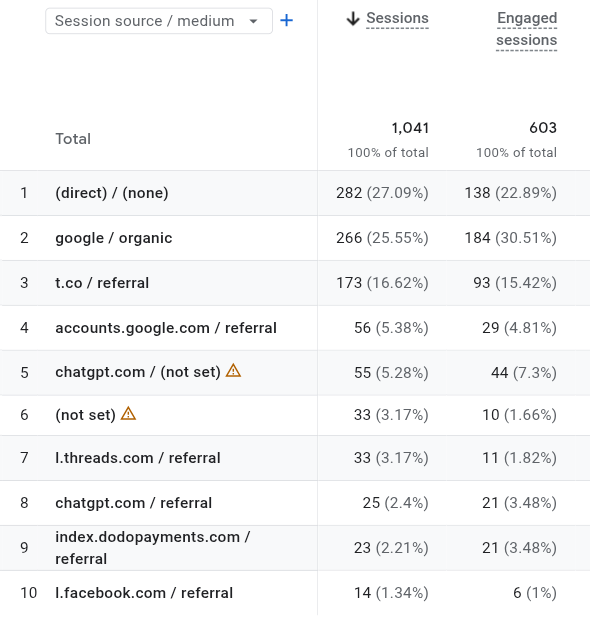
| Metric | Sessions | Growth |
|---|---|---|
| Google Organic | 266 | +850% (Explosive Growth) |
| ChatGPT (Total) | ~80 | High Growth |
The “False Positive” Trap
As the publishing engine ramped up, both traffic sources skyrocketed.
- Google began indexing more keywords and trusting the site structure.
- AI had more data points (tokens) to reference for user queries.
The Danger of this Data
This phase represents the most dangerous period for analysis because it creates a False Correlation.
Looking at this chart, a marketer would naturally assume: “My AI traffic is growing because my SEO is improving.”
This is incorrect.
They were not growing because they are connected. They were growing because they were both being fed the same fuel: Activity. As Phase 4 below, eventually proves, these two growth lines are parallel, not dependent.
Phase 3: The Velocity Spike
Period: December 2025
Context: Peak Holiday Season
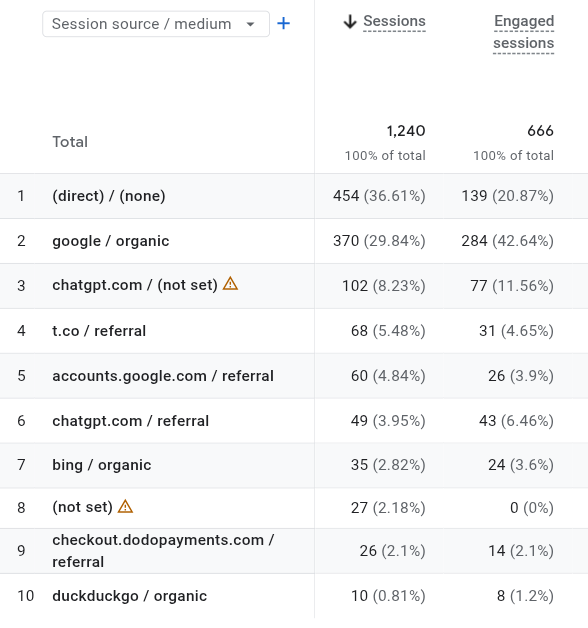
| Metric | Sessions | Growth |
|---|---|---|
| Google Organic | 370 | +39% (Linear Growth) |
| ChatGPT (Total) | ~151 | +88% (Exponential Growth) |
The Analysis
In December, AEO began to decouple from SEO. While Google traffic saw steady, linear growth, AI traffic nearly doubled.
Why did AI outperform Google during the peak?
The answer lies in User Intent Complexity. During the holidays, users stop searching for simple keywords (e.g., “red sweater”) and start asking complex, contextual questions (e.g., “What is the best gift for a 30-year-old who likes hiking and red sweaters?”).
- Google offers a list of links (requiring the user to research).
- AI synthesizes an answer (doing the research for them).
Because the brand had Fresh, Semantically Rich Content, the LLMs prioritized it as the “solution” for these conversational queries. The AI’s Knowledge Graph updated faster than Google’s “Link Graph,” allowing it to capture the seasonal surge immediately.
Phase 4: The Great Divergence (The Critical Finding)
Period: January 2026
Status: Publishing Halted (Reduction to 1 post/month)
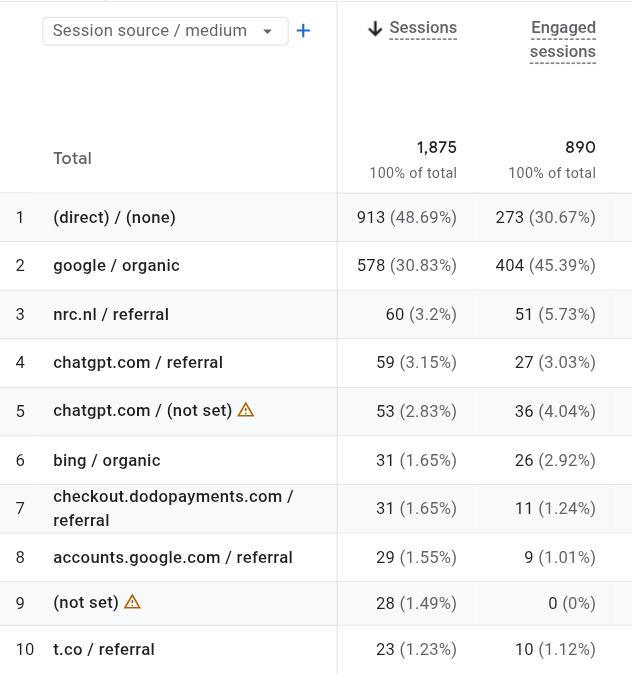
This is the most critical data point in the study. After three months of consistent “feeding,” we stopped the FlipAEO content engine.
| Metric | Sessions | Growth/Decay |
|---|---|---|
| Google Organic | 578 | +56% (Continued Growth) |
| ChatGPT (Total) | 111 | -26% (Immediate Crash) |
The Paradox
Why did Google traffic double while AI traffic crashed?
This singular event highlights the fundamental architectural difference between the two search eras.
1. Google is “Lagging” (Authority-Based)
Google ranks you based on Reputation. The backlinks, site structure, and content depth we built from Oct–Dec solidified the domain’s authority. Even though we stopped writing in January, Google still “trusted” the site.
- Result: You can “cash in” on past SEO work for months or years.
2. AI is “Leading” (Freshness-Based)
LLMs, especially those connected to live search (SearchGPT, Perplexity, Bing)prioritize Currency. When the “Publishing Heartbeat” stopped, the AI deprioritized the brand for current queries.
- Result: AI visibility is not an asset you own, it is a stream you must maintain.
The “Not Set” Collapse (The Smoking Gun)
The most damning evidence lies in the specific breakdown of ChatGPT traffic.
The chatgpt.com / (not set) metric which typically represents high-intent, deep-research, or SearchGPT queries dropped from 102 sessions to 52 (-49%).
This confirms that while general “chat” traffic might linger, the AI completely stops serving your content as a “news” or “current” source the moment the data feed goes cold.
Starting Feb, we are starting the content publishing again with 2x velocity, 2 articles/week. We will monitor the changes in ai traffic to confirm our results of the last 4 month. Any findings will be updated here end of month.
In-Depth Analysis: The Mechanics of Visibility
The divergence in January 2026 allows us to construct a comparative model for how AEO (Answer Engine Optimization) differs from traditional SEO.
Based on the dataset, we have identified three governing laws of AI visibility.
1. The “Freshness Floor” Theory
Our data suggests that AI Search operates with a significantly higher “Freshness Floor” than Google.
- SEO is a Library: You can publish a definitive guide in 2024 and still rank #1 in 2026 without touching it. Google treats the content as an “asset” that retains value.
- AEO is a Stream: LLMs prioritize currency. When our content velocity dropped (Phase 4), the AI detected a “Content Gap.” The algorithm likely reduced the probability of citation because the brand’s data was no longer part of the active, living conversation.
The Rule: In AEO, you do not “own” a ranking; you “rent” it with consistency.
2. Probabilistic vs. Deterministic Ranking
The reason Google traffic remained stable while AI traffic crashed lies in the fundamental math of the engines.
- Google is Deterministic: It uses a rigid set of rules (Backlinks + Keywords + Site Speed = Rank). Because the site’s structure remained sound in January, the traffic remained stable.
- AI is Probabilistic: LLMs work by predicting the next best token. They operate in a vector space. If your brand stops generating new tokens (content), the mathematical probability of the AI selecting you as the “next best answer” decreases.
By stopping production, we essentially removed the brand from the probability pool of the “current” vector space.
3. The “Ranking Threshold” Myth
This study definitively debunks the industry belief that you must be #1 on Google to be visible in ChatGPT.
In Phase 1 (October), the brand had zero Google rankings but measurable AI traffic. This proves that LLMs utilize RAG (Retrieval-Augmented Generation) to scan for Semantic Relevance, not Domain Authority.
- Google asks: “Who is the most popular source for this query?”
- AI asks: “Who has the specific sentence that answers this question?”
If your content contains the specific vector embedding that solves the user’s problem, the AI will bypass the “Google Sandbox” entirely and cite you immediately.
The AEO Playbook: 3 Strategic Recommendations
If you are optimizing for the AI era, the “publish and pray” method is dead. Based on this study, here are the three non-negotiable strategies for maintaining visibility in LLMs.
1. Consistency is the New Authority
In traditional SEO, you build links to establish authority. In AEO, you must build Relevance Velocity.
- The Mistake: Our test subject stopped publishing in January, and the AI immediately devalued the brand.
- The Fix: You must maintain a “content heartbeat.” You cannot let your site go cold. Even updating existing articles with fresh data, current dates, or new nuances signals to the LLM that your information is alive and valid.
2. Hunt the “Long-Tail Answer”
The October data proved a critical rule: You can win without ranking.
The brand received AI referrals in its first month with zero Google rankings because it answered questions nobody else was answering.
- The Strategy: Stop chasing high-volume keywords. Start chasing high-context questions. If you provide the best specific answer to a niche problem, the AI must cite you, regardless of your Domain Authority.
3. Build a Hybrid Moat
The January crash taught us that SEO is your safety net, but AEO is your growth engine.
- The Balance: Do not abandon SEO best practices (structure, schema, speed); they kept the traffic alive when production stopped. However, to capture the exponential growth seen in December, you must treat your content as a live stream, not a static library.
Final Verdict
This case study definitively dismantles the idea that AEO is just “SEO 2.0.”
They are not the same vehicle. They are fundamentally different engines that run on different fuels.
- Google consumes Authority. It looks at your backlinks and history. It rewards you for what you did.
- AI consumes Freshness. It looks at your velocity and data density. It rewards you for what you are doing.
For brands looking to dominate the future of search, the lesson is clear:
You do not need to be #1 on Google to be #1 in ChatGPT. But you cannot go silent. In the age of AI, silence is invisibility.