
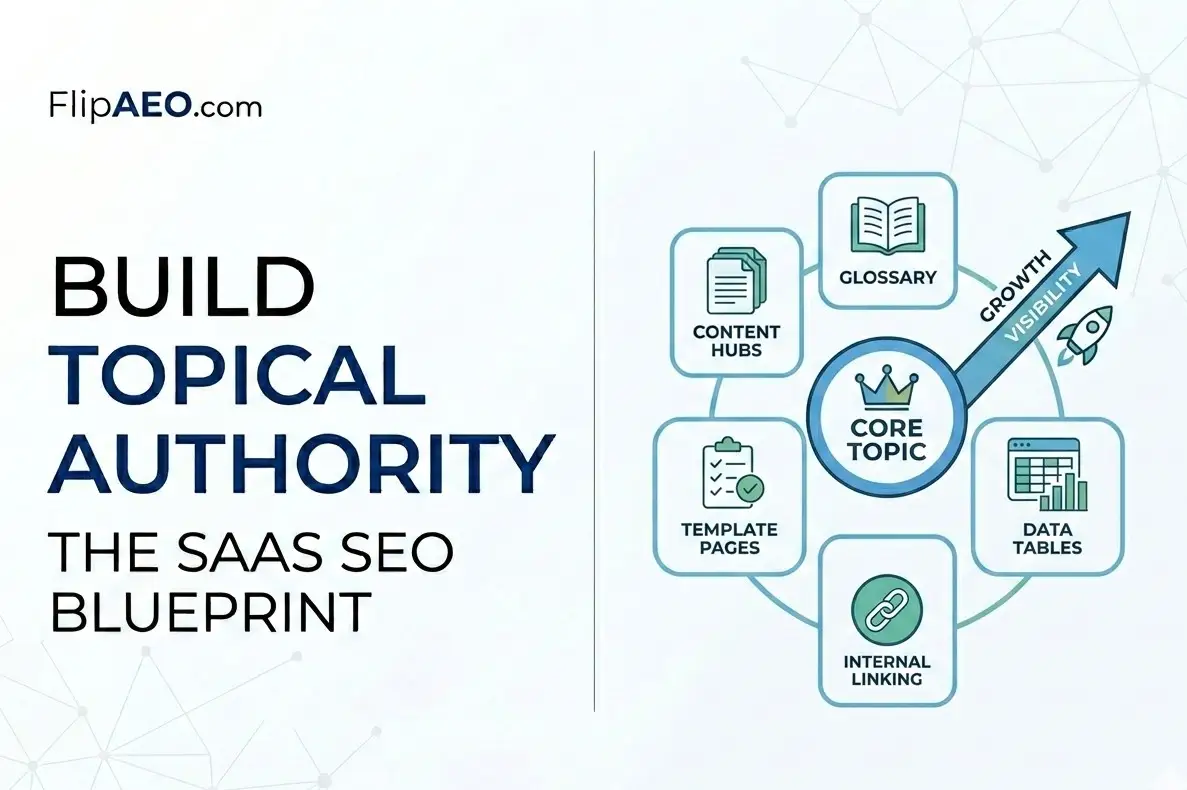
Topical Authority is the strategy of covering a specific subject comprehensively across a network of interconnected content to prove expertise to search engines.
As search shifts from traditional Google links to AI-driven Answer Engines, brands must adapt this strategy using Generative Engine Optimization (GEO). This requires formatting content into highly structured, machine-readable “chunks” rather than traditional, long-form blog posts.
If you study the fastest-growing SaaS companies of the last decade, giants like Mailchimp, Wrike, and Drift—it’s easy to think their success was a product of massive budgets or timing. But ignore the the branding for once, and you’ll find they all executed the exact same underlying mathematical strategy to capture millions of organic visitors: Topical Authority.
They didn’t just write blog posts. They built semantic empires.
But as we move deeper into 2026, the rules of this game are undergoing a massive shift. We are moving from the SEO Era to the AEO (Answer Engine Optimization) Era.
In the old SEO model, your goal was to rank a single page for a specific keyword. In the new AEO model driven by AI search engines like ChatGPT, Gemini, and Perplexity, the goal is to be recognized by Large Language Models (LLMs) as the definitive “Entity Owner” of an entire topic.
In this masterclass, we are going to deconstruct exactly how 7 SaaS giants built their organic moats. More importantly, we’ll break down the mechanics of why they won, and show you how to build your own “Mini-Drift” or “Mini-Mailchimp” engine without needing a 50-person marketing team.
What is Topical Authority in the AI Era?
Topical Authority is the process of proving to a search engine or Large Language Model (LLM) that your website is the definitive expert on a specific subject. In traditional SEO, the goal was to rank a single page for a specific keyword. In the AI era, the goal is “Semantic Coverage.” You must blanket an entire topic so AI models recognize your brand as the definitive “Entity Owner.”
Why Google Loves It: Google’s brain, the Knowledge Graph, doesn’t just read words; it connects concepts. It inherently trusts websites that connect the dots between broad topics and granular sub-topics.
Why AI (ChatGPT) Loves It: AI search engines operate on a framework called RAG (Retrieval-Augmented Generation). When a user asks a complex question, the AI retrieves answers from sources that look like complete, highly structured datasets. If your website only covers half a topic, you have gaps in your content. To an AI model, a gap in content is a gap in trust.
How 7 SaaS Giants Built Topical Authority
The most successful SaaS companies engineered their organic growth through rigid content structures. Below is a breakdown of the specific tactics used by 7 industry leaders to capture high-volume traffic.
| SaaS Company | Core Strategy | Content Format | Monthly Organic Traffic |
|---|---|---|---|
| Wrike | Brute Force Coverage | 300+ interlinked blog posts | 215,000 |
| Drift | Pillar & Cluster Architecture | Organized Content Hubs | 580,000 |
| Mailchimp | Definitional Intent | Marketing Glossary | 215,000 |
| Rows | Utility Content | 50 interactive calculators | 45,000 |
| Typeform | Bottom-of-Funnel Intent | 1,300+ specific templates | 55,000 |
| Loom | Product-Led Hook | Hardware testing tools | 21,000 |
| Exploding Topics | Data Authority | Programmatic statistic pages | 201,000 |
Deconstructing the 7 SaaS Authority Frameworks
Each of these companies succeeded because their content was built for scale and structure. Here is the mechanical breakdown of their strategies.
1. Wrike: The Brute Force Coverage Strategy
Wrike established authority by publishing over 300 highly specific articles surrounding the single primary keyword of “Project Management.”
Wrike didn’t just want to rank for “project management”, they wanted to own the entire concept.
To do this, they published over 300 highly specific blog posts surrounding that single primary keyword. By breaking down every conceivable sub-topic (from “project management workflows” to “SEO team task allocation”) and linking them back to core pillar pages, they built an impenetrable wall of topical relevance, driving over 215k monthly visits.
- The Tactic: They blanketed the “Long Tail” of search.
- The AI Lesson: Volume plus relevance equals authority. You cannot be a partial authority in the eyes of an LLM. To rank for a Head Term, a site must thoroughly cover every sub-topic (e.g., Gantt charts, Kanban boards, Agile workflows).
2. Drift: The Pillar and Cluster Architecture
Drift captured 580k monthly visitors by building rigidly organized “Content Hubs” centered around the topic of Conversational Marketing.
Before they were acquired, Drift mastered the pillar-cluster model. They didn’t just write long-form guides; they built highly organized “Content Hubs.” Every broad topic had a central pillar page, surrounded by specialized cluster articles. Crucially, every article featured a sidebar internally linking to related pieces. This rigid, organized taxonomy signaled intense topical depth.
- The Tactic: Drift used a Hub-and-Spoke model. Every broad Pillar Page was surrounded by specialized Cluster Pages.
- The AI Lesson: Internal linking is a website’s neural network. A blog post without internal links is a dead end. AI crawlers use internal links to understand the relationship and hierarchy of your data.
3. Mailchimp: The Dictionary Strategy
Mailchimp captured top-of-funnel traffic by creating a massive, highly structured Marketing Glossary.
- The Tactic: They targeted “Definitional Intent” by explicitly defining industry terms.
- The AI Lesson: Own the definition. LLMs actively seek concise, factual definitions to serve as direct answers to users. Structuring content as a glossary makes it highly extractable for AI systems.
4. Rows: The Utility Content Approach
Rows generated 45k monthly visits by developing 50 specific calculators designed to solve niche business problems.
- The Tactic: They prioritized utility over written reading material.
- The AI Lesson: Utility beats fluff. Content that actively solves a problem keeps users engaged. Content must be deeply actionable and “How-To” focused, not just theoretical.
5. Typeform: The Bottom-of-Funnel Template Strategy
Typeform captured high-intent traffic by creating over 1,300 specific templates for distinct user needs.
- The Tactic: They targeted granular, Bottom-of-Funnel (BoFu) queries (e.g., “Wedding RSVP form”).
- The AI Lesson: Granularity wins. Specificity captures users who are past the research phase and are actively ready to convert.
6. Loom: The Product-Led Hook
Loom captured 21k monthly visits by creating simple, user-friendly tool pages to test webcam and microphone settings.
- The Tactic: They intercepted users at the exact moment of hardware frustration.
- The AI Lesson: Intercept the problem. By solving an immediate tangential problem, Loom seamlessly introduced its video messaging product as the ultimate solution.
7. Exploding Topics: The Data Authority
Exploding Topics drives 201k monthly visitors by programmatically creating industry-specific statistic pages filled with visual trend data.
They programmatically scales industry-specific statistic pages filled with visual data. By becoming the definitive source for “trend data.”
- The Tactic: They positioned themselves as the primary source for hard numbers.
- The AI Lesson: Data is trust. In an era of AI hallucinations, LLMs prioritize citing sources that provide hard statistics, structured lists, and verifiable data points.
The Execution Gap: Why You Haven’t Done This Yet
If the blueprint is so obvious, why isn’t every website driving traffic like Drift or Mailchimp?
Because knowing the theory and actually executing it are two entirely different things.
- Barrier 1: Time. Executing the Wrike strategy requires writing 300 highly researched articles. For a human, that is a two-year roadmap.
- Barrier 2: Cost. If you outsource this to an agency to build out a proper “Topic Cluster,” you are looking at retainers upwards of $10,000+ per month.
- Barrier 3: Structure. Planning the Hub-and-Spoke internal linking architecture (like Drift) requires deep technical SEO knowledge. If you link it wrong, the Knowledge Graph won’t understand the relationship between the pages.
The result? Most founders and marketers default to publishing random, disconnected blog posts and ultimately fail to move the needle.
If you want to be cited as the source of truth by an LLM, the old SaaS playbook requires a massive update. Here is what is actually driving visibility today:
1. Structure > Domain Authority
LLMs are compute-sensitive. They are designed to extract precise answers quickly. Because of this, an Answer Engine will actively bypass a DA 90 website if the answer is buried in a dense wall of text. Instead, it will pull from a DA 0 website sitting on Page 2 of Google simply because the answer is neatly formatted in a high-density table, a structured list, or a direct definition.
The Data: 30% to 40% of ChatGPT citations are currently pulled from Google Page 2 or lower. You no longer need to outrank the giants to out-cite them.
2. AEO is a “Live Stream”, SEO is a “Library”
Traditional SEO coasts on historical backlinks. A strong page can rank for years with zero updates. AI search models, however, demand a “Content Heartbeat.” They are biased toward fresh, real-time data. If your content velocity stops, your AI visibility decays immediately (data shows a 26% drop in ChatGPT referrals the moment publishing halts).
3. The Triangle of Visibility
To secure brand citations in an AI-driven world, your content must hit three marks:
- Indexability: You still need to be accessible (Top 30-50 on Google).
- Topical Purity: Providing specialized, niche data rather than broad generalizations.
- Structural Trust: Data must be explicitly formatted for machine extraction.
While Google is currently rewarding messy, subjective Reddit threads, ChatGPT is ignoring them in favor of structured, niche authority sites. AI uses Wikipedia for the “What” and highly structured niche sites for the “How.”
How to build Structural Topical Authority at scale
Building 300 manual blog posts like Wrike or coding 50 custom calculators takes massive agency retainers and years of effort. But reverse-engineering the Retrieval-Augmented Generation (RAG) pipelines of today’s Answer Engines doesn’t require a $5,000/month SEO agency.
It requires a dedicated content infrastructure.
When you are a solo founder focused on building useful apps that actually solve pain points, you don’t have the luxury of a 50-person content team or a massive marketing budget. You need infrastructure that does the heavy lifting for you.
FlipAEO solves this exact pain, not as just another “AI Writer,” but as a Strategic Content Engine designed explicitly to build Topical Authority in the Post-SEO era.
Here is how FlipAEO automates the exact strategies used by the giants:
Executing the “Wrike” Strategy (Volume & Coverage)
FlipAEO generates up to 30 deeply researched articles a month. It allows a lean team or a solo operator to completely match the output volume of a venture-backed marketing department, ensuring you can blanket your niche and establish undeniable relevance.
Executing the “Drift” Strategy (Strategic Clustering)
You don’t need to manually map out complex spreadsheets to track your links. FlipAEO automatically interlinks your content. It mimics the Hub-and-Spoke model by linking your topical clusters together dynamically, ensuring search engines perfectly understand your site’s architecture without creating isolated, “orphan” pages.
Executing the “Mailchimp” Strategy (Structured Formatting)
AI engines demand high information density. FlipAEO is heavily optimized for RAG pipelines. It doesn’t just write walls of text; it automatically structures your content with bold definitions, structured lists, proper heading hierarchy and data tables. This mimics the “Glossary” format that LLMs actively prefer to cite.
The “Set and Forget” Workflow
You simply input your brand url and FlipAEO’s engine takes over. It first runs a deep topical authority audit, finds the gaps that niche is missing on web, maps out the necessary sub-topics, then builds a Strategic Content plan every month and writes the structured content. This is how your internal authority is built.
Conclusion
The days of “lucky” SEO and ranking on the back of a few disjointed blog posts are over. As search shifts toward AI-driven answer engines, the winners will be the brands that engineer their success through dense, highly structured Topical Authority.
You have a choice: You can build this architecture manually, spending years of time and thousands of dollars or you can use an engine specifically designed to execute it for you.
Start building your first Authority Cluster today at FlipAEO.com