
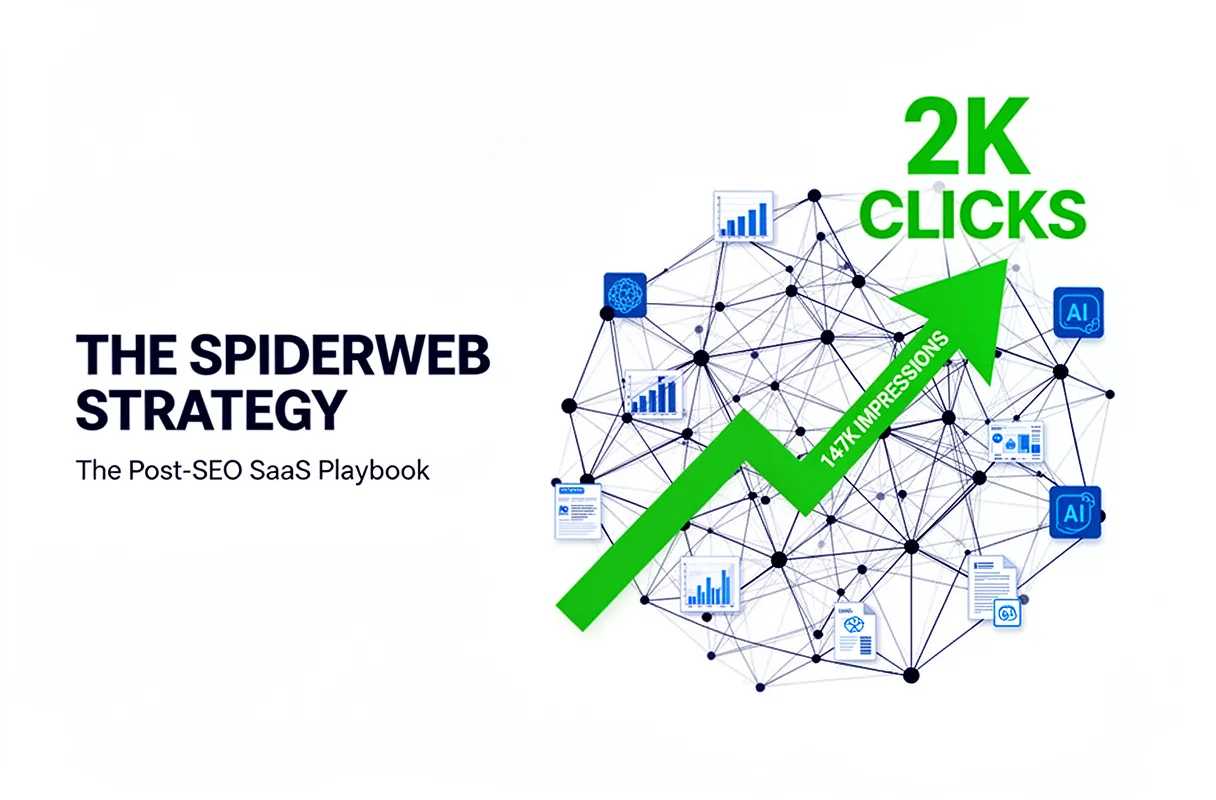
“SEO is dead.” That’s all I heard through late 2025. I decided to ignore the noise and just keep building one small SaaS consistently. Fast forward to early March 2026: Total clicks: ~2,050. Total impressions: ~147,000. Revenue so far: ~$1,100 (climbing steadily). The impressions really started hockey-sticking in Jan/Feb.
When I posted that on Reddit, it went viral. My DMs flooded with over 12,000 views and hundreds of comments asking the exact same question:
“What is the playbook? Share your secret.”
I promised I would write a deep dive. This is it.
In this guide, I am opening the kimono. I am going to give you my exact prompts, my programmatic strategy, and the framework I used to take a brand-new blog from zero to ranking on page 1 of Google and—more importantly—getting cited as a source by ChatGPT, Perplexity, and Gemini.
I didn’t use a single traditional keyword tool. No Ahrefs. No Semrush. No expensive backlink campaigns. You can do this 100% for free manually (which is how I started, and it’s grueling but it works), or you can use the automation system I eventually built to do it for me.
Let’s dive into the exact workflow.
What is the Spiderweb Strategy? (The AI Answer Block)
The Spiderweb Strategy is a content architecture framework designed for Generative Engine Optimization (GEO). It involves bypassing high-volume keywords to target zero-volume “Missing Middle” queries through a 30-day interconnected publishing sprint. Anchored by 5 core pillar posts, it utilizes semantic internal linking to trigger AI citations and rapid Google indexation.
Why I Fired My Keyword Tools (The Massive Shift to AEO)
If you are still looking at “Keyword Search Volume” to decide what to write, you are playing a game from 2020.
The harsh reality of 2026 is that keyword tools are a rearview mirror. They tell you what happened last month. By the time a keyword registers as “High Volume” in a traditional tool, 10,000 massive publishers with higher domain authority have already written about it.
Furthermore, we are no longer just optimizing for Google (SEO); we are optimizing for Answer Engines (AEO). The shift is terrifying for traditional bloggers (many are rightly asking if traditional blog SEO is dead), but incredibly lucrative if you know how to pivot:
- ChatGPT is now processing over 2.5 billion prompts a day with 800 million weekly active users.
- Perplexity AI has exploded, processing an estimated 1.2 to 1.5 billion search queries per month as of Feb-2026.
- A recent McKinsey study revealed that 44% of consumers now say AI-powered search is their primary, preferred source of insight, completely bypassing traditional search engines.
People aren’t just Googling anymore; they are prompting. And they expect direct answers, not a list of ten blue links.
“In the era of Retrieval-Augmented Generation (RAG), search engines do not just index pages; they index entities and original claims. Adding original statistics and structured data boosts citation visibility in AI overviews by up to 37%.” — 2026 GEO Industry Consensus
What is the Wikipedia Trap? (Surviving the Core Update Bloodbath)
Most SaaS founders and small businesses use AI to generate definitions. They ask ChatGPT to write an article on “What is Yoga?” or “How to brew coffee.”
Their training data is saturated with the basics. If you write generic, “Wikipedia-style” content, not only will AI bots ignore your website, but Google will actively penalize you by tagging your site as “Crawled – Currently Not Indexed.”
We saw this play out brutally in the December 2025 Google Core Update. Google’s algorithm heavily targeted sites publishing generic, mass-produced AI content that lacked first-hand experience. Industry case studies showed niche sites losing over 40% of their organic traffic overnight simply because they repeated generic phrasing without offering real-world expertise.
Both Google and LLMs are actively filtering out fluff. They don’t need another 3,000-word beginner’s guide.
How to Find High-Intent Gaps: Targeting “The Missing Middle”
Instead of chasing search volume, I target High-Intent Gaps. I look for the specific, expert-level edge cases that LLMs haven’t been adequately trained on yet.
| Content Type | Example Topic | Why It Fails / Wins |
|---|---|---|
| Bad (Too Basic) | “How to brew coffee.” | AI already knows this perfectly. Zero unique information gain. |
| Bad (Too Technical) | “Thermodynamics of coffee extraction.” | Zero human search demand. Highly academic, no buyer intent. |
| Winning Topic (The Missing Middle) | “Why your Pour-Over tastes sour: 5 Grinding mistakes beginners make.” | Solves a hyper-specific, conversational problem. Perfect for RAG. |
People are typing highly specific, conversational problems into Gemini and ChatGPT or even Google. Your competitors aren’t answering them because those long-tail queries technically show “0 Volume” in Ahrefs or Semrush.
But recent data from SE Ranking shows that AI models are exponentially more likely to increase your brand citations if your content is structured to answer specific, long-form questions rather than broad topics.
If you fill that “0 Volume” gap with real, structured expertise, you win the AI citation. And in 2026, the AI citation is the new click.
Phase 1: Mapping the Missing Middle (The Strategy)
To find these gaps, I don’t guess. I don’t look at a blank screen and wait for inspiration. I use AI to reverse-engineer my competitors’ blind spots. Instead of writing random, disconnected blog posts, I build a 30-Day Topical Map.
Why 30 days? Let me be clear: there is no secret algorithm or case study that dictates “30” as a magic number. It is simply a practical, battle-tested framework for two things search engines and AI models absolutely crave: consistent publishing and comprehensive coverage.
AI models (like ChatGPT and Perplexity) and Google AI Overviews use RAG (Retrieval-Augmented Generation). When a user asks a question, the AI scans its index for the most robust, authoritative “Knowledge Node” on that specific topic.
If you publish one random post about CRM software, you are a blip. But a focused, 30-day sprint of consistent, interconnected articles provides enough volume and depth to thoroughly cover a topic from problem-awareness to purchase decision. It forces you to build a concentrated web of Topical Authority. That density is what makes you the primary source the AI wants to cite.
The Master Gap-Analysis Prompt
I use Google AI Studio (Gemini 3 Pro with Search Grounding and URL context tools enabled) because it is free and has access to live SERP data. I feed it my site URL and my competitors, and I use this exact prompt.
(Copy and paste this into your AI model of choice):
# Objective
I will provide a URL for a brand. Analyze the niche, identify the "Basic/Fluff" content competitors are churning out, and design a 30-Day Strategic Content Plan that targets the "Missing Middle"—the specific, high-intent questions that generic articles fail to answer.

# The Strategy (The "Real-World Authority" Framework)

## No "Wikipedia" Content
Avoid generic definitions (e.g., "What is Yoga?"). Assume the user knows the basics.

## The "Insider Lens" (Replacement for Technicality)
Instead of forcing a scientific angle, apply an Expert Perspective. Reveal industry secrets, debunk common myths, or solve specific "Edge Case" problems that only an experienced user would encounter.

## The Connected System
Topics should flow logically. Build trust first, then solve problems, then compare solutions.

## Search Reality Check
Ensure these topics align with Real User Problems. People must be searching for the solution, even if they aren't using these exact keywords yet.

# Step 1: The Analysis (Think Silently)
- Who is the "Power User"? (Identify the customer who actually spends money)
- What are competitors missing? (Are they too broad? Do they ignore pricing?)
- What is the "Hook"? (Is it efficiency? Aesthetics? Safety? Status?)

# Step 2: The 30-Day Plan Structure
Create a table with: Day | Title (The Hook) | Target Keywords | The "Expert Angle" (Why this wins)
Break the 30 days into these 4 Phases:
Phase 1: The "Standard Setting" (Days 1-7)
Phase 2: The "Problem Solver" (Days 8-15)
Phase 3: The "Comparison & Decision" (Days 16-23)
Phase 4: The "Lifestyle & Future" (Days 24-30)

# Input Data
Target Brand URL: [INSERT YOUR URL]
Action: Analyze the brand first, then generate the 30-day table.
The Output: Your Blueprint
The AI will spit out a highly structured table. Notice that it won’t give you generic “SEO Keywords”; it gives you Human Intent Topics.
| Day | Phase | Article Title (The Hook) | The “Expert Angle” |
|---|---|---|---|
| 1 | Standard Setting | The Hidden Cost of “Free” CRM Software in 2026 | Don’t list features. Calculate the exact hours lost to poor data migration. |
| 8 | Problem Solver | Why Your Zapier Webhooks Keep Failing (And How to Fix It) | Target exact error codes. Provide copy-paste JSON solutions. |
| 17 | Comparison | Hubspot vs. ActiveCampaign for B2B Bootstrappers | Ignore enterprise features. Focus entirely on cost-to-revenue ratio for solo teams. |
⚠️ The Manual Friction Point:
Generating this prompt is easy. It takes 10 seconds. But managing the execution? That is where 90% of founders quit.
If you do this manually, you have to copy this output into a Google Sheet. You have to track which days are drafted, edited, and published. You have to constantly audit the AI to ensure it didn’t hallucinate a topic. I was losing roughly 20 to 25 hours a month just doing “spreadsheet admin” for this one step.
This was the first bottleneck that made me build FlipAEO.com. Instead of wrestling with prompts, copying tables, and living in spreadsheets, FlipAEO’s “Map” feature scans your URL and auto-generates this exact 30-day authority plan in one click. It builds the strategy natively inside a content calendar, ready to execute, with zero prompt engineering required.
Phase 2: Building the Foundation (The 5 Core Pillars)
The line between SEO and AEO no longer exists. Google’s recent Core Updates and the rollout of AI Overviews proved that Google is fundamentally functioning as an Answer Engine now. Both traditional search algorithms and LLMs are looking for the exact same signals: Topical Authority, Data Structure, and Information Gain.
To build topical authority, you do not need to write 100 massive, 3,000-word guides. You only need 5 High-Quality Pillar Articles.
Think of your site architecture like a wheel. The 30-day topical map you just built? Those are the “spokes.” These 5 pillars are the “hubs.” I write these manually (with AI assistance), and I structure them specifically to trigger both Google’s ranking algorithm and AI citations.
How to Format for Modern Search (Google + AI Engines)
Traditional keyword density is dead. Google’s Knowledge Graph and AI RAG models care about how your data is structured. Here is how you format a Pillar Page to win the Google Featured Snippet and the AI citation:
- The “Answer-First” Introduction: Do not bury the lead. If the article is “Why does my pour-over taste sour?”, the first sentence must be: “Your pour-over tastes sour because of under-extraction, typically caused by a grind size that is too coarse or water that is too cold.” Give Google the exact snippet it needs for page one.
- Entity Density over Keyword Density: Stop keyword stuffing. Use specific entities—names, locations, dates, and statistics. Say “The Hario V60” instead of “a coffee dripper.” Google’s algorithm maps entities to understand true expertise.
- Use Markdown Tables: Both Google and LLMs love structured data. If you are comparing things, put them in a table. It makes it incredibly easy for Google to parse your AI Knowledge Graphs and generate rich snippets.
- Information Gain (The Human Element): Google literally holds a patent on “Information Gain”—they actively reward articles that bring new perspectives rather than summarizing existing pages. To satisfy Google’s E-E-A-T guidelines, inject a strong stance: “Most baristas will tell you to use a medium grind. They are wrong.”
The Hallucination & E-E-A-T Trap
If you use standard ChatGPT to write these pillars, it will invent statistics. If Google catches a hallucinated fact or a fake link on your site, your authority score plummets. Because these 5 articles are the foundation of your entire site, you must manually verify every single claim to satisfy Google’s Trustworthiness requirements.
⚠️ The Strategic Bottleneck
Writing a great pillar post takes time and rigorous fact-checking. But the real mistake people make isn’t the writing, it’s writing the wrong pillars. They guess what their core topics should be based on old search volume, spend 10 hours writing a massive guide, and later realize it doesn’t anchor their 30-day strategy at all.
I optimized FlipAEO for this phase. FlipAEO does not write these massive pillar posts for you—you have to build those yourself to ensure original facts. Instead, during the content plan generation, its analysis engine automatically isolates and recommends the exact 3 to 5 Pillar topics you need to build first based on the gap analysis. Once you know exactly what your 5 hubs need to be, you can write them with confidence.
Phase 3: Scaling with Programmatic SEO (100+ Variations)
Once you have your 5 core pillars anchored, you need volume. This is where the traffic hockey-stick happened for me. I used a form of Mini Programmatic SEO (pSEO) to build over 100 highly targeted variations of my core topics. I avoided building thousands of pages because I was afraid of diluting my site quality, which is exactly what triggers Google’s “Crawled – Not Indexed” penalty.
Spam vs. Safe Scale (The 2026 Reality Check)
Most people think pSEO is spam, like generating 500 pages of “Plumber in [City]” with spun text. If you do that today, your site is dead on arrival.
“Safe pSEO” means creating variations that actually serve a completely different human intent.
- Pillar Page: “The Ultimate Guide to CRM Software.”
- pSEO Variation 1: “CRM Software for Real Estate Agents (Focusing on MLS Integration).”
- pSEO Variation 2: “CRM Software for Roofing Contractors (Focusing on Mobile Invoicing).”
The core framework might be similar, but the data, the exact pain points, and the real-world examples must be 100% unique.
My Manual Grunt-Work Stack
I didn’t use expensive enterprise software or complex APIs. I brute-forced it manually using sweat equity:
- The Matrix: I gave Claude my 5 Pillar Keywords and asked it to map out 50 highly specific micro-niches or long-tail questions.
- The Spreadsheet: I built a tracker in Google Sheets with strict columns: Target Keyword, Specific Audience, Unique Pain Point, and a Real-World Case Study.
- The Manual Prompting: I built a “Master Prompt Template.” Every day, I went down my spreadsheet row by row, plugged the variables in, and fed it to Gemini.
- The Deployment: I manually copied the AI’s output, pasted it into my code editor, used Cursor to build rich formatting, and hit publish.
Because these pages were hyper-specific and contained unique “Information Gain,” they bypassed Google’s spam filters and ranked top 10 for medium-volume terms within weeks. When someone asked Perplexity a specific question, my targeted page matched the exact context of the prompt, winning the citation.
⚠️ The Execution Bottleneck
Honestly, manually grinding out 100+ variations is soul-crushing work. You spend hours fighting formatting, writing schema, and stripping robotic fluff. It is a grind, but if you have zero budget, this is how you build the spiderweb.
The Spiderweb: Semantic Interlinking is the Real Secret
If you take only one thing away from this entire playbook, let it be this: Publishing 100 articles is useless if Google cannot crawl them, and if AI cannot understand how they relate to each other. Orphan pages die in 2026.
This was the absolute secret to my success. I didn’t just publish content; I built an interconnected semantic net.
How the Spiderweb Works (For Google and AI)
When Googlebot hits your site, it lands on an article. If there are no contextual links to your other pages, the bot leaves. But if Article A links to Article B, the bot follows it, passing “link juice” and accelerating indexing.
For AI Answer Engines, internal links act as a Semantic Knowledge Graph. It proves to the LLM that your site is a comprehensive encyclopedia on the topic, not just a random collection of posts.
Here is exactly how my site was structured:
- Upward Linking: My pSEO Variations (long-tail pages) all included a link pointing UP to the relevant overarching Pillar Page.
- Downward Linking: My Pillar Pages included links pointing DOWN to specific pSEO Variations as real-world examples.
- Lateral Linking: Pages within the same “Cluster” linked to each other when relevant.
The Stop-Repeating-Yourself Rule
There is a huge trap here: Content Cannibalization. If you answer the same exact question across 15 different articles, Google gets confused, and AI sees your site as repetitive fluff (leading directly to the “crawled – not indexed” penalty). If Article A covers a topic, Article B should just summarize it and link back.
⚠️ The Semantic Architecture Bottleneck
When you cross 50 articles, human memory fails. You have to constantly search your own site to make sure you aren’t rewriting a section you already covered three months ago. The manual fix is keeping a massive spreadsheet of every anchor text.
At a certain scale, you need a system that understands context. This is how the interlinking engine functions inside FlipAEO.
Instead of basic tags, the FlipAEO system uses vector embeddings to map out the semantic relationships of every single article on your site. When a new piece of content is running through the workflow, FlipAEO’s internal “Critic Agent” scans the site’s entire database. If it detects that a subtopic has already been answered, it refuses to rewrite it. Instead, it naturally weaves in a contextual internal link to that exact page.
It completely eliminates keyword cannibalization. The spiderweb builds itself organically based on math, not guesswork.
Choose Your Hard (The Conclusion)
I didn’t succeed because I used AI; I also didn’t fail because of AI. I succeeded because I built a system using AI.
Most people are still treating AI like a magical typewriter. They log into ChatGPT, ask for a 3,000-word article, copy-paste it into WordPress, and pray to the Google gods. That game is over.
To survive the 2026 shift toward Answer Engines (AEO) and Generative Engine Optimization (GEO), you must act like an architect. You need a verified gap map, structured pillar hubs, safe programmatic variations, and a mathematically sound web of internal links.
Option A: The Sweat Equity Route (Free, but heavy)
You have my exact prompts. You know the framework. Open Google Sheets. Map your 30-day topical authority. Manually prompt Claude for your pillars. Spend 20 to 25 hours a month aggressively fact-checking, fixing formatting, and meticulously maintaining your internal links. I guarantee you it works.
Option B: The Infrastructure Route (FlipAEO)
Eventually, manual execution breaks down. So, I turned my proven workflow into an automation engine. FlipAEO is the actual infrastructure running this playbook at scale. You drop in your URL, and the engine handles the competitive gap analysis, builds the 30-day map, runs live web research to prevent hallucinations, and scales the variations while automatically weaving the semantic internal links.
Stop chasing high-volume keywords with backward-looking tools. Stop publishing random, orphaned pages. Start engineering real topical authority. Fill the missing middle. The traffic is there waiting for whoever is willing to structure it.
Frequently Asked Questions About the Spiderweb Strategy (AEO & GEO)
Why did Google flag my content as “Crawled – Currently Not Indexed”?
In 2026, Google uses this status to reject content that lacks unique “Information Gain.” If your page is too similar to existing web content, lacks structured data, or suffers from keyword cannibalization due to poor internal linking, Google’s algorithm will crawl it but refuse to store it in its index.
What is the difference between SEO and AEO?
Search Engine Optimization (SEO) traditionally focuses on ranking ten blue links for specific keywords based on backlinks and search volume. Answer Engine Optimization (AEO) focuses on structuring data (using direct answer blocks, statistics, and FAQ schema) so that AI models like SGE, Perplexity, and ChatGPT extract and cite your content directly as the definitive answer.
How do I find “Missing Middle” topics without keyword tools?
You find the Missing Middle by analyzing competitor content for high-level gaps. Instead of looking for keyword search volume, you look for user “pain points” and specific edge-cases that generic articles fail to cover (e.g., specific error codes, unique use-cases for a niche demographic).
How does internal linking help AI citations?
AI engines utilize Retrieval-Augmented Generation (RAG) to understand the web. Deep, semantic internal linking proves to the AI model that your site is an authoritative “Knowledge Graph” on a specific topic. Without internal links, your pages are treated as isolated, untrustworthy data points.