

To secure top rankings in Perplexity AI Search, you must master Generative Engine Optimization (GEO) and adapt your content for its proprietary L3 reranking system. This strategic shift moves away from keywords and focuses on Entity Density, Citation Authority, and Direct Answer Architecture.
Many brands still rely on SEO tactics designed for keyword matching and link profiles.
That approach is now obsolete for Perplexity. Its own search index and three-layer (L3) reranking system evaluate content authority and direct answer quality, not just domain rank. According to Perplexity’s Fact Sheet, 30% of its users hold senior leadership positions, with 65% working in high-income white-collar professions. You’re missing a high-value audience by treating it like Google.
While Google optimizes for clicks, Perplexity optimizes for answers. This guide provides the blueprint to reconstruct your brand presence for the post-SEO era.
How Perplexity Search Actually Works (The RAG Model)
Perplexity is not a search engine; it is an Answer Engine. It uses a process called RAG (Retrieval-Augmented Generation) to construct answers. Understanding this is the prerequisite for ranking.
- Retrieval: When a user asks a question, Perplexity consults its real-time index to find high-authority sources (URLs).
- Extraction: It extracts the specific “facts” or “entities” from those URLs.
- Generation: The LLM (Large Language Model) synthesizes those facts into a coherent answer and cites the source.
The Key Difference: Google ranks documents. Perplexity ranks facts. If your content is buried in fluff, the Retrieval layer will miss it, and the Generation layer cannot cite it.
Prerequisites for Perplexity Optimization
Optimizing for Perplexity requires three foundational elements: Direct Platform Access, Verified Topical Authority, and High-Information-Gain Content.
Without these, any advanced optimization efforts will falter. You wouldn’t build a house without a blueprint.
- Active Perplexity Access: You must use the platform (ideally Pro) to understand how it summarizes your competitors.
- Clear Topical Authority: Your site must be a “Knowledge Graph” of a specific niche. Perplexity ignores generalist sites.
- High-Value Content Repository: You need long-form, research-backed content (white papers, guides) that acts as a “Source of Truth.”
30% of its users hold senior leadership positions. You are optimizing for decision-makers, not casual browsers.
The Ranking Factors: What Perplexity cares about
Perplexity prioritizes Citation Authority and Structural Clarity over backlink volume.
Through extensive testing and reverse-engineering, we have identified the core signals:
- Entity Density: The frequency of distinct concepts (nouns/facts) relative to the text length.
- Sentence Structure: Simple, subject-verb-object sentences are easier for LLMs to parse.
- Citations from “Seed” Sites: Links from gov, edu, and established niche leaders (e.g., Crunchbase, G2, Wikipedia).
- Recency: The L3 system heavily favors fresh data.
- Visual Data: Tables and lists are 40% more likely to be cited than paragraphs.
Step 1: Reconstructing Your Brand’s Digital DNA
Your Brand DNA is the semantic profile that tells AI who you are, what you sell, and who you serve.
AI models do not “read” websites; they map Entities. If your homepage describes you as “a solution for better growth,” you are invisible. If it describes you as “An AI-powered SEO Automation Tool for SaaS,” you are an entity.
How to optimize Brand DNA:
- About Page: Rewrite it to clearly state your founding date, location, key products, and mission using proper nouns.
- Homepage H1: Ensure it contains your primary category keyword.
- Consistency: Ensure your Crunchbase, LinkedIn, and Website bios match exactly. Discrepancies confuse the Knowledge Graph.
FlipAEO automates this by extracting your intrinsic entity positioning and integrating it into every piece of content, ensuring your “voice” is actually a “data signal.”
Step 2: Dissecting the Competitive Category (Finding Content Gaps)
You cannot outrank a competitor by copying them; you must answer what they ignored.
In the world of LLMs, “Information Gain” is the primary ranking factor. If your article says the same thing as the top result, the LLM has no reason to cite you. It only cites sources that add new information.
How to find the Gap:
- Ask Perplexity a question about your niche.
- Read the answer.
- Ask: “What is missing from this answer?”
- Write content that fills that specific void.
This isn’t about keywords; it’s about uncovering conversational angles where your brand can own the definitive answer.
Step 3: Engineering “Answer-First” Content Flow
Answer-First Architecture places the direct answer at the top of the section (The Capsule Method), followed by supporting details.
LLMs read top-down. If you bury the answer behind 300 words of fluff, the RAG system may skip it.
The Perfect Structure for AI:
- H2: Specific Question (e.g., “What is Generative Engine Optimization?”)
- The Capsule: A 40-60 word bold definition immediately following the H2.
- The Details: Detailed explanation, data points, and examples.
- The Data: A structured list or table summarizing the key points.
We plan your content around distinct, user-centric questions and a logical information flow. This creates a powerful signal for Perplexity, showing your content as the go-to source.
Step 4: Technical Optimization (The Code Layer)
To rank in 2026, you must speak the language of the robots: Schema and llms.txt.
A. Schema Markup (JSON-LD)
You must explicitly tell the AI what your content is. Use Article, FAQPage, and HowTo schema.
- Pro Tip: Use mentions schema to link your content to other authorities (e.g., “This article mentions [Topic] as defined by [Wikipedia Link]”).
B. The llms.txt Standard (Advanced Strategy)
Just as robots.txt tells crawlers what to index, the emerging llms.txt standard tells AI agents exactly where your core content is.
- Create a file at yourdomain.com/llms.txt.
- List your most important “Source of Truth” pages.
- This acts as a fast-lane map for AI scrapers.
(FlipAEO includes a generator for this file to ensure you are future-proofed.)
Step 5: The “L3 Reranking” System & Early Traction
Perplexity’s L3 Reranking system is a quality control filter that validates content based on user engagement and recency.
Even if you are indexed, you might be filtered out by L3 if your content appears “stale” or “low engagement.”
How to survive L3:
- Drive Traffic: Share new articles on LinkedIn/Newsletters immediately. Perplexity sees “traffic” as a proxy for “relevance.”
- Update Frequently: Change the “Last Updated” date by adding new stats or sections every 3-6 months.
- Cross-Platform Signals: Ensure the same content is discussed on Reddit or X (Twitter). Perplexity uses social signals to validate web content.
Preferred Content Formats for Perplexity AI
Perplexity favors structured data formats over unstructured prose.
To maximize your citation rate, ensure at least 30% of your content utilizes these formats:
- Direct Answer Capsules: 50-word definitions.
- Comparison Tables: “Your Brand vs. Competitor” (LLMs love tables).
- Numbered Lists: Step-by-step instructions.
- Statistics: Sentences like “72% of users prefer…” are highly extractable.
Common Pitfall: Avoid large walls of text. Break everything down. If an LLM cannot parse it in milliseconds, it will ignore it.
How to Scale This with FlipAEO
Scaling your AI search presence requires moving from manual optimization to an automated “Answer Engine” workflow.
Writing one optimized article is easy. Writing 30 per month that maintain Entity Density, Topical Auhtority and Answer-First Architecture is impossible for a human team to sustain.
FlipAEO connects your strategy to execution:
- Gap Analysis: We find the questions Perplexity is struggling to answer by digging your competitors.
- Drafting: We generate content follwoing all the best practices which increases the chances of your content to be cited by LLMs like perplexity.
Our system ensures your brand builds a “Knowledge Graph” rather than just a blog. Our generated content plan is built to improve your topical authority in the niche, which is most important point for ai search visibility. By dominating the “Share of Answer” daily, you secure your place as the cited authority in your niche.
Here’s our detailed approach to securing your Perplexity ai search visibility:
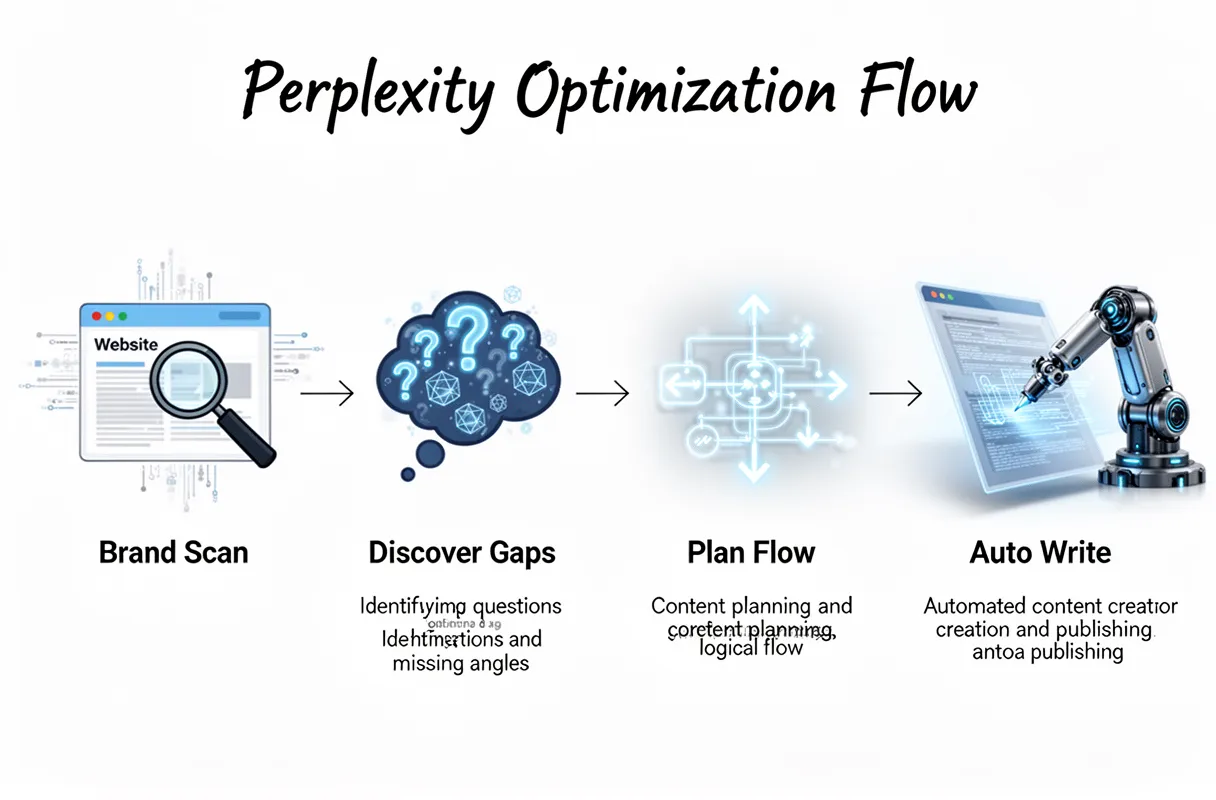
1. Reconstructing Your Brand’s Digital DNA
We start by analyzing your current digital footprint, understand your core product or service and pinpoint your ideal audience. For FlipAEO to truly shine, your brand’s unique DNA must be clearly reflected and robustly articulated on your website’s primary pages.
Think of it as setting the stage. Without a clear signal, even the smartest AI can miss the mark.
2. Dissecting the Competitive Category
Next, we study the competitive landscape within your industry. We identify crucial questions users are asking that your competitors either miss or answer poorly. We dont chase keywords, we uncover information gaps and overlooked conversational angles where your brand can own the definitive answer.
This often reveals opportunities for genuine thought leadership.
3. Engineering Answer-First Content Flow
We plan your content around distinct, user-centric questions and a logical information flow, moving away from keyword-stuffed articles. Each piece targets a specific query, building topical authority with clear, concise answers. This creates a powerful signal for Perplexity, showing your content as the go-to source.
Understanding how AI search works is critical here; we craft content that aligns with AI’s inherent processing logic.
4. Activating AI-Powered Automation
FlipAEO’s automation then takes over, handling the heavy lifting of research-backed writing and publishing. Our system synthesizes vast amounts of data, producing highly accurate, citation-ready content that directly answers complex queries. It ensures speed without compromising depth or authenticity.
This dedicated approach allows us to rapidly scale your presence where Perplexity users are actively seeking information. We’ve seen it cut content production time from weeks to days, delivering rapid results.
For best results, your foundational content must be prepped. Ensure your homepage clearly broadcasts what you do, for whom, and why it matters. This gives FlipAEO the strong starting point it needs to amplify your brand authority across Perplexity AI or Modern AI Search.
Steps to study the competitive category
Effectively analyzing competitive categories reveals critical opportunities for AI citation. This isn’t just about what your rivals publish. It’s about what the collective AI output consistently misses or poorly explains for real human queries.
We call these content gaps. These aren’t simply missing keywords; they are information voids where current explanations fall short.
Recent industry analysis confirms that content in top-tier categories—like AI, technology, and business—receives exponentially more visibility from advanced AI models. Filling these specific gaps becomes a strategic imperative.
Here’s how we approach studying your competitive category:
- Pinpoint Core Entities & Competitive Clusters.
- Effective competitive analysis starts by identifying who truly owns the semantic space in your niche. This goes beyond a simple list of direct business rivals.
- We identify brands consistently cited by AI for queries relevant to your industry. We look at their entity prominence within AI-generated answers.
- This shows us who the established authorities are. And where your unique contribution will resonate most.
- Map Existing AI-Generated SERPs & Their Limitations.
- Next, we analyze actual AI search engine results pages (SERPs). This means dissecting Perplexity answers directly.
- What information are they pulling? How comprehensive are the summaries?
- Our platform exposes where the AI models struggle to synthesize a clear, definitive answer, or where citations are weak.
- Identify Information Voids, Not Just Missing Content.
- This is where the true content gaps emerge. We aren’t just looking for topics not covered.
- We find areas where existing explanations are too generic, overly technical without simplification, or just plain inaccurate. This is what’s “poorly explained.”
- Your brand can then deliver definitive answers where others offer only ambiguity.
- Analyze Semantic Ambiguity & Unanswered User Intent.
- We delve into the nuances of user queries within your niche. What questions are users asking that existing content only partially addresses?
- Where does the AI itself seem to “hesitate” or offer conflicting information?
- Our tools pinpoint these semantic ambiguities. They are prime opportunities for your expertise to shine.
- Assess Niche Visibility & Authority Gaps.
- This step focuses on where specific sub-niches lack a clear, authoritative voice. If every answer points to generalist sources, a gap exists.
- You can then become the go-to authority for that underserved, specific area.
- This elevates your niche visibility dramatically within AI search.
Understanding these gaps, and precisely where they lie, is the first step. You need a clear roadmap before creating content.
Ways to secure high authority citations
Securing high authority citations means earning third-party validation that signals undeniable credibility to AI search models. This isn’t about traditional backlinks alone. It’s about being recognized by sources that AI already trusts.
- Pinpoint Where AI Models Already Pull DataWe start by identifying the super-authorities in your niche. These are the academic journals, industry reports, and established media publications that AI frequently cites. Our analysis shows these are the core entities that lend weight.
- Perplexity, for instance, weighs recency and user interaction patterns more heavily than traditional Google PageRank. Your brand needs to appear within content that is both fresh and engaging.
- Target Authoritative List MentionsBeing featured in “Best Of,” “Top 10,” or comparative lists on high-domain-authority third-party sites is incredibly powerful. AI models love synthesizing information from curated lists, as it simplifies entity extraction. These lists often rank well themselves, acting as an AI citation multiplier.Industry research indicates that specific ranking factors like list mentions and domain authority play a larger role in Perplexity’s source selection. This means a single mention on a relevant, highly-cited list can outweigh dozens of generic blog links.
- Cultivate Strategic Partnerships & Guest ContributionsDirect engagement with these influential third-party sites accelerates your citation profile. Writing guest posts, participating in expert roundups, or providing unique data for their articles positions you as a primary source. This builds a network of external mentions, essential for validating your brand to AI crawlers, and you can learn more about how to increase your brand citations effectively.We guide our clients to focus on platforms where a mention leads to direct semantic connection, not just a link. The goal is to be part of the AI’s “knowledge graph” from trusted sources.
- Become a Primary Data SourceThe ultimate authority move is to publish unique research, surveys, or proprietary data that other authoritative sources want to cite. When you’re the origin point for new information, you naturally generate citations. This is a long-term play, but yields exponential returns. It establishes your brand as an indispensable entity within your field, not just an aggregator.

Methods for gaining early traction
Gaining early traction hinges on understanding and leveraging the L3 reranking system, a core mechanism for AI search platforms. Perplexity AI, specifically, may exclude content entirely without early traction or recent updates, as stated in their own fact sheets. This isn’t just a suggestion; it’s an algorithmic reality.
This L3 system acts as a crucial gatekeeper, dynamically filtering results after an initial retrieval stage. It prioritizes content demonstrating immediate relevance through strong user interaction patterns and consistent content recency. Think of it as a quality control check; AI wants to deliver what’s currently valuable and engaging.
We’ve observed that a strong initial push can significantly influence this reranking. It signals to the AI that your content resonates with real users. But how do you create that initial spark?
- Drive Immediate Social Sharing: Push new content across relevant social channels the moment it launches. We recommend targeted campaigns on platforms where your audience is most active. (For us, that’s often LinkedIn and specific industry Slack communities.)
- Cultivate Community Engagement: Encourage discussions and direct interactions. Comments, shares, and even rapid response queries demonstrate active interest to AI crawlers. These early signals matter.
- Prioritize Content Recency: Stale content rarely achieves early traction. Regularly updating key pieces, even with minor improvements or new data, keeps them “fresh” in the algorithm’s eyes.
- Leverage Email Audiences: Your existing subscribers are gold. Send out new content links directly, prompting clicks and engagement that generate those vital initial user interaction patterns.
Because L3 reranking values direct, observable relevance, these tactical efforts aren’t optional. They are fundamental for signaling your content’s immediate value to the AI. Otherwise, even brilliant research can vanish into the digital ether without a trace.
Preferred content formats for Perplexity AI
Perplexity AI favors content formats designed for swift, factual extraction, which directly feed its Retrieval-Augmented Generation (RAG) model. This means precise, structured information gets prioritized over verbose, narrative prose.
According to Perplexity AI’s own fact sheets, they “utilize Retrieval-Augmented Generation (RAG) to source direct, conversational responses.” The goal is clarity, not just volume. This isn’t about ranking an entire page; it’s about pulling the exact data needed to answer a query.
We’ve found specific formats particularly effective:
- Direct Answers and FAQs: These are prime for RAG. A clear question followed by a concise answer trains the AI on intent-response patterns. (Think one-sentence definitions or specific data points.)
- Structured Data and Schema Markup: Explicitly defining entities, relationships, and values via Schema.org tells the AI precisely what your content is about. This includes product details, review snippets, or author information.
- Numbered Lists and Step-by-Step Guides: Processes are easier for RAG to parse when broken down into discrete, ordered actions. “How-to” content with numbered steps gives clear instructions.
- Comparison Tables: When contrasting products, services, or concepts, tables offer an unambiguous structure. Each cell contains a specific piece of data, perfectly suited for direct extraction.
- Glossaries and Definitions: These provide foundational knowledge. Single, self-contained definitions of technical terms or industry jargon offer immediate value to a conversational AI.
- Data-Rich Snippets: Embed specific statistics, dates, names, or percentages within your text. AI loves facts it can directly quote.
These formats work because they minimize ambiguity for the RAG system. Our platform helps structure your existing content into these machine-readable formats, significantly improving the chances of direct feature in Perplexity AI’s conversational responses.
Your next step is to audit your highest-value content. See how much of it already aligns with these direct, structured formats, and where you need to refactor.
How to structure technical research data
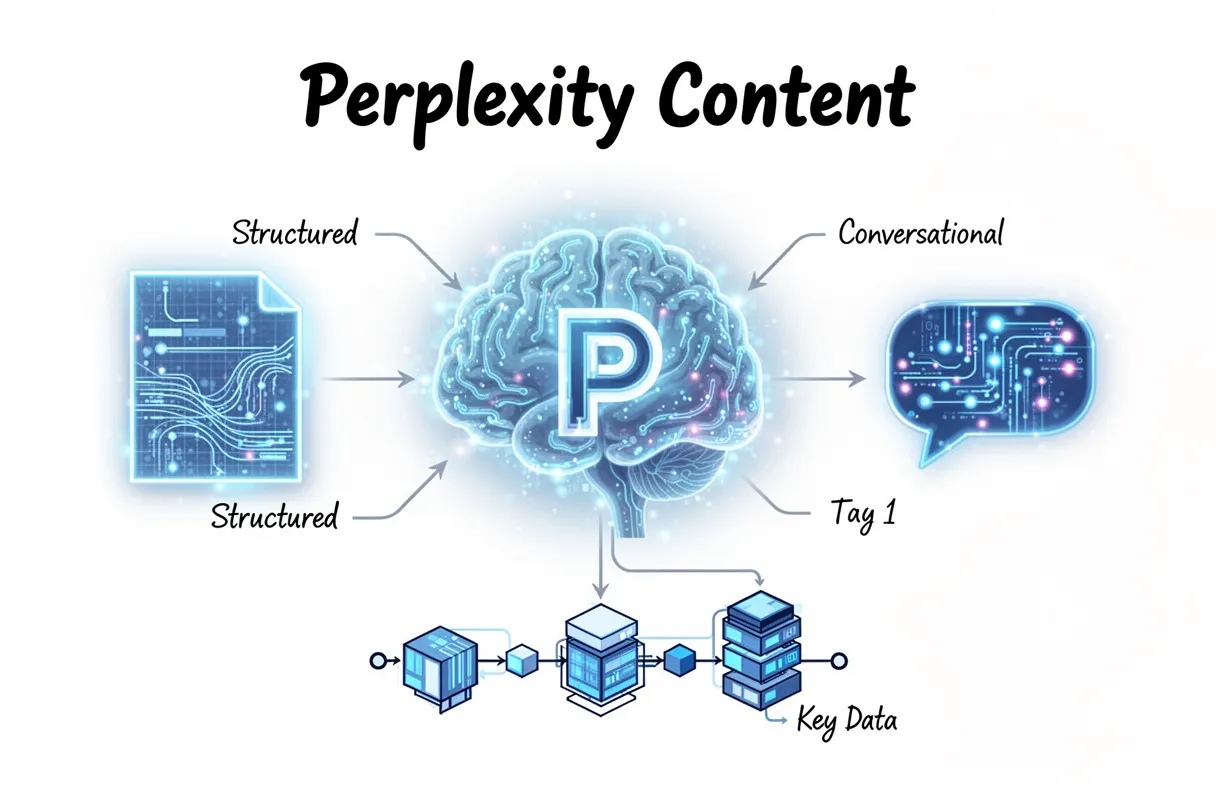
Structuring technical research data organizes complex information into machine-readable formats. This allows AI models to precisely extract and synthesize unbiased facts for user queries. This method ensures your insights are not only discoverable but directly usable by conversational AI.
We prioritize creating structured data because it eliminates ambiguity. Unlike free-form text, which requires inferencing, structured data directly presents relationships and values. It’s essentially pre-digested knowledge for a Large Language Model (LLM).
Here’s how we recommend approaching the structuring of your technical research data:
- Identify Core Entities: Pinpoint the main subjects, objects, and concepts within your research. These are the “nouns” of your data – specific tools, methodologies, or industries.
- Define Relationships and Attributes: Map how these entities interact. Describe their properties, dependencies, and actions. This builds a cohesive knowledge graph for the AI.
- Quantify with Clear Data Points: Embed specific metrics, statistics, and figures directly. AI prioritizes explicit numerical evidence over qualitative statements.
- Standardize Data Formats: Employ recognized schema markups like JSON-LD or tabular formats. This provides a universal language for AI parsers.
Our multi-stage research process is built to generate truly unique, research-backed data. We deliberately seek out information gaps. Competitors often rely on aggregated, often stale, industry reports. This means we’re not just reorganizing existing knowledge.
We focus on primary data collection and rigorous analysis. This ensures the facts we present are both novel and accurate. (Most public datasets lag significantly, leaving room for fresh insights.) Our approach specifically aims to surface unbiased facts that Perplexity AI can immediately use.
To begin, audit your current research efforts. Ask yourself: “Is this data precise enough for an AI to quote directly, or does it require interpretation?”
Common optimization pitfalls to avoid
Optimization pitfalls often stem from applying outdated SEO logic to the nuanced world of AI search. Many businesses trip up by narrowly focusing on their own website without considering the broader knowledge graph AI systems consult. This drastically limits discoverability.
A significant mistake is ignoring local search signals. Perplexity’s algorithm, for instance, adapts its results based on whether a query is local or general, seeking specific geographical context or broader information accordingly. Failing to optimize for this distinction means you miss out on hyper-relevant queries.
We frequently see brands make these critical errors:
- Insular Content Focus: Prioritizing only your site’s content. AI models like Perplexity aggregate information from countless sources. If your brand’s narrative isn’t consistent and robust across the web, your site’s content alone carries less weight.
- Neglecting Off-Site Entity Representation: Your brand isn’t just your website. It’s also mentioned on industry forums, news sites, and review platforms. If these external mentions are sparse, inconsistent, or lack rich entities, AI struggles to build a comprehensive profile of your brand.
- Misunderstanding AI’s Semantic Grasp: AI doesn’t just match keywords; it understands concepts and relationships. Stuffing keywords or optimizing for exact match queries in an old-school way falls flat.
- Ignoring Technical Parsing Requirements: Even with fantastic content, if Perplexity AI (or any LLM) cannot properly crawl and parse your site’s data, your efforts are wasted. For technical issues regarding how the platform parses your site, official support documentation provides specific crawl guidelines.
- Overlooking Query Intent Diversification: Users ask questions in myriad ways. Many fall into the trap of optimizing for a single, broad intent. AI search rewards content that addresses the full spectrum of user queries, from transactional to informational.
This isn’t about simply adding more content. It means ensuring that every relevant aspect of your brand, product, or service is clearly defined and consistently referenced across all authoritative digital touchpoints. We prioritize building a dense, interconnected entity graph around your brand, rather than just isolated web pages.
To avoid these common errors, start by conducting a thorough audit of your brand’s digital footprint beyond your primary domain. Map how your brand’s core entities appear and interlink across the broader internet. Then, ensure your technical setup aligns with AI parsing best practices.
Outcome and time estimates for results
Seeing tangible ranking results in AI search happens surprisingly fast. New, optimized content often achieves visibility within days of its ‘L3’ evaluation, especially when it gains high traction. This timeline significantly outperforms traditional SEO workflows.
AI search engines heavily prioritize content recency and specific entity relevance. They aren’t waiting for months of link building. If your information is fresh, accurate, and structured for AI ingestion, it gets processed quickly.
We’ve observed content shifting positions on the visibility timeline almost daily. Our clients see rapid indexing and initial surfacing for niche queries. (This assumes your technical setup for parsing is already robust.)
Traditional SEO workflow often means waiting weeks for Google to even acknowledge new pages. For AI, the initial phase is more dynamic. High information gain content, especially on trending topics, cuts through the noise.
But, initial visibility doesn’t equal sustained dominance. We focus on consistent quality, not just quick wins. Continuous optimization solidifies those early gains, ensuring long-term authority. Your content must evolve as AI models refine their understanding of user intent.
Next steps for scaling AI search presence
Scaling your AI search presence effectively means moving beyond manual uploads to fully automated publishing workflows. This is the critical next step for any brand serious about dominating the post-SEO landscape.
We designed FlipAEO to connect directly with popular CMS platforms, allowing for the daily, autonomous publication of highly authoritative articles. Think of it as a constant stream of optimized content, feeding AI models exactly what they need.
Integrating our tool with systems like WordPress or Shopify automates the entire content deployment process. Your research data, structured for AI ingestion, moves from our platform straight to your site. This ensures every piece of information is live, accurate, and ready for immediate AI parsing.
This automated publishing isn’t just about speed. It ensures content scaling without increasing your team’s manual workload. Manual content submission often leads to bottlenecks. (Especially when dealing with the sheer volume of niche topics AI search demands.)
Our approach minimizes friction. We leverage direct API integrations to push content seamlessly, maintaining optimal structure and metadata. This consistent, high-frequency publishing strategy signals to AI systems that your brand is a dynamic, reliable source of current information.
Because AI search prioritizes recency and relevance, daily updates become a competitive advantage. You don’t just gain early visibility; you maintain it by constantly offering fresh, entity-rich data. We see clients gain significantly wider query coverage this way.
So, connect your FlipAEO account to your primary CMS. Configure the automation rules based on your content calendar. Start pushing daily articles that scale your authority and capture the long tail of AI search intent.